(INSERT BLOG POST HERE)

I’m gripped wholly by a powerful wave of depression I can’t seem to shake. I have no cute, pithy, or otherwise useful words to contribute to the canon, today.

But it’s important to treat yourself as you would another (the better corollary for the ‘Golden Rule’) and I’d definitely have more grace for a stranger than I naturally offer myself. So my advice this week is to do a self-inventory. Find the aches and pains in your body and your soul and invest in rounding out their rougher edges.

As for how you should do that? Shit, I don’t know. I was going to turn off the lights and stare at a lit candle until I find center.

You?

“I hate to advocate drugs, alcohol, violence or insanity to anyone…but they’ve always worked for me.” – Hunter S. Thompson

~~~

He grasps at straws

With the reckless abandon

Of a man slipping quickly

Off a ledge into the abyss

He stared in

too long

Too deep

Too far

Each swat of his hand

At the retreating,

Fleeting,

Vestiges of chances

Pushes them further out

Into space.

Close enough to be seen

But never close enough

To be reached again.

And first he feels his left foot

Slip.

And then he feels

So heavy for a moment

And then like he

Weighs nothing at all

As the cool black embrace

Rises up to greet him

To come and swallow him whole.

The Parable of the River-Baby

Today, I’ll (try to) keep things brief.  I’d like to share with you a parable that’s something of a north star in my life:

One morning, you awake to discover that the bend in the river near where you live is absolutely *silly* with babies.  All kinds.  You’re perplexed, but leap immediately into action, alongside several of your close friends (who also hate to see babies struggling in the slow eddy).  You fish baby after baby out of the blue-green water, placing them on the shore and unsure of what to do with all these babies.  Where did they come from?  Is it your job to get them to somewhere else?  That seems crazy and unfair.  You did your part.  The babies aren’t in the river anymore; so you just keep fishing, dying, and tossing shoreward.  

Your friends, less baby-friendly, only have about a week’s worth of baby fishing in them.  The first one leaves, very reasonably, to check on his dying mother.  The second, less reasonably, says they read on the internet that 100% of all murderers used to be babies, and that they won’t have anything to do with ‘your agenda.’  The third, fourth, and fifth who leave give no excuse, but steadily turn their attention elsewhere–either to other issues or totally inwards for some well-earned, congratulatory navel-gazing.  

And so you’re alone, feverish and sweaty even though you’re waist deep in cold, flowing water.  You’re losing feeling in your fingers.  The low, moaning drone of babies gurgling in the stream haunts you when you’re not fishing them out.  You can’t live your life just passing by this every day.  You lose your job over it, because there just aren’t enough hours, but no one is going to pay you to fish these babies out of the river.  You ‘volunteer.’  Then suddenly there’s *more* babies.  They come down the way in passels and in clutches, like little tumorous masses of mewling.  They aren’t even wearing diapers.  

That’s how they find you:  slumped from exhaustion, cradling all the river-babies you alone couldn’t help, and angry at *yourself* for failing at what you feel to be your essential calling.  

Now, you made a noble existence, for as long as you could, doing the “right” thing.  Without you, those babies would’ve been without any recourse except to drown or be dragged further down into harsher rapids.  You should be proud, somewhat, except for the fact that you’re kind of an idiot.  

“WHAT?!?!  SIR!  I’LL HAVE YOU KNOW I’M SAINT SUSAN OF THE RIVER BABIES AND I WILL NOT HAVE MY GOOD WORKS ANALYZED BY THE LIKES OF YOU!”

  1. You’re pretty touchy there, Hypothetical Susan and…
  2. You could’ve done a lot more with a lot less effort if you thought about the whole system and not just the symptoms of that system.  

“…wut?”

Yeah, exactly.  You saw babies in the river.  You reactionarily jumped into action, fishing those babies out day in and day out–and I applaud you–but the babies still roll, and in greater numbers.  All because someone, somewhere knows someone, somewhere will fish them out.  You’d have been a damn sight better served to hike your happy ass up the river and see who is throwing babies in.  They aren’t arriving there spontaneously.  This isn’t their natural habitat.  99.99% of the time, whatever problem you’re looking at (River Babies or Homelessness or Gun Violence or Addiction) is the *symptom* and not the *system*.  

Marching up the river, you can easily see that it’s Hypothetical Donald, tossing babies in the river to make room for his summer home.  In all fairness, he’s actually taking them out of the hospital where they’re born–because he knows a hospital who loses all its babies to the river won’t be around very long.  Hypothetical Donald, despite his morbid awfulness, is aware that dismantling the system is the only path to victory.  Taking one afternoon, making a little walk upstream, and punching your Hypothetical villain right in the frick-frackin’ face would be the most efficient, expedient, and satisfying conclusion to the journey.  

No babies in the river; no asshole upstream.  And that’s it.

Now, no one is going to come along 1000 years from now and write this parable in red letters between a bunch of magic I did (but, man, I do have this *one* card trick…).  Quite frankly, you’re probably thinking:  “Well, duh, of course that’s how I’d handle it.”

But you’re wrong.  The life you lead is artificially limited by the assholes throwing babies in the river so you never notice the proverbial forest you’re standing in because you’re too busy keeping one of several trees from falling on your nest egg at any given moment.  

So, when you see homelessness, I encourage you to help as you are able–but I encourage you more to think long and hard about how and why that person is in the street.  Moreover, consider that if his great-great grandad had done the same thing, it would’ve been called “homesteading” and he’d have been “free” to protect the corner of the world he took with lethal force.  The great, expansive cattle-ranches-cum-factory-farms out west?  The names on them are soaked in blood–and not just bovine.  

When you hear about a mass shooting, we leap immediately to the weapon itself and ignore that the human capacity for malice is what’s growing more troublingly.  We like to pretend people disproportionately target schools because of some underlying, transcendent, quasi-divine “evil,” and neglect the fact that the modern school system is just where most people are most miserable.  I’d be just as upset to discover mass hammer-slaying incidents have become common–or else the violent slice-n-dice knife culture of Scotland made the leap across the pond.  Until the underlying system is better, any tool in any hand is just as likely to be a weapon.  

And (for fuck’s sake) when you see thousands of homeless, strung out on opiates, you can thank the fact that pharmaceuticals research and production is cornered wholly by the baseless depravity of corporate socialism (a total oxymoron) and “profit margins” are antithetical to the common good.  Just ask Big Tobacco…or big Gambling…or big Booze…shit, actually just ask anyone who ever made a billion dollars.  

Thus, I’ll ask you:  Do you want to spend your life thanklessly fishing someone else’s mess out of the river by your home or would you rather root out the essential brokenness and demand action?  

I know where I stand, but it means putting in the intellectual work necessary to discern what is really from what is purported to be.  My fear of late is that capacity has been irreparably damaged.  I implore you to prove me wrong.  

Do good; Be well,

–The Strangest

Tomorrow, and tomorrow, and tomorrow…

Patrick Stewart learned from Ian McKellen that it’s the “ands” and not the “tomorrows” that drive the rhetorical motion of Macbeth’s famous soliloquy. It’s the recognition of the enduring passage of time. Tomorrow is an object; the “and” is the turmoil about it’s impending arrival, both in the text and in the world.

Why do I mention it?

Because life has a way of happening. There’s no meaty diatribe today. There’s only 1)this apology for my slack-ass, which you’re currently reading and will cease at the ellipsis to the right…

…and a simple request.

Between this week and next, when I’ll be back to senselessly radicalize the (nonexistent) masses towards humanism, take stock of the world immediately around you. If you can’t walk there, or otherwise wouldn’t, it doesn’t count. This week, think about the world you can physically touch–about your daily experience if you could only travel on foot.

Would you be happy with the world that’s been built for you? I am, but I had the luxury of choice and chose wisely. Many people don’t. Most of them you can’t help.

But I bet you *could* do something for someone or something immediately nearby. The incredible thing about America (if there are any left) is that it was built, originally, burgh by burgh–block by block. That national level so opaque to we peasants is as ephemeral as any massive organization. The local, however, is yours to command. Build the world you want to see in your own back yard, and you’ll be pleasantly surprised to find the bigger picture looks a lot your back yard, only bigger.

Discover your neighborhood this week–and if you don’t have one, ask why.

Do good; be well,

-The Strangest

“Come with me…and you’ll see…a woooorld of human degradation…”

Hey, I’ll be honest, I’m sitting at the bottom of a barrel and looking up some awfully steep walls.  Writing my way out of it this week seems impossible.  Instead, I’d like to enlighten any of you who aren’t aware exactly *what* I’m so mad about all the damned time.  I read this article this morning:  https://www.just-food.com/news/nestle-accused-of-double-standards-over-sugar-in-baby-formula-cereals/

And realized I’m particularly sick of a literal evil empire we all universally condone with inaction.  

So, this is the Nestle Corporation, writ large:

  1. Infant formula scandal:

In the 1970s, Nestlé began aggressively marketing its infant formula in developing countries, particularly in Africa, Asia, and Latin America. They discouraged breastfeeding and encouraged mothers to switch to formula feeding, even in areas with limited access to clean water and adequate sanitation.

Nestlé was caught giving free samples of infant formula to hospitals and maternity wards…but only so much as to last long enough for the mother’s milk to dry up, as it’s definitely a “use it or lose it” skill.  The company also hired “milk nurses” to visit homes and promote formula feeding, dressed in uniforms resembling those of health care professionals.  

Those unsanitary conditions I mentioned?  Yeah, they led to widespread malnutrition, diarrhea, and infant deaths.  Nestlé prioritized profits over the health and well-being of infants in developing nations.

In 1974, the British charity War on Want published a booklet titled “The Baby Killer,” targeting Nestle’s abuses of the Global South. The report was translated into German with the (much punchier) title “Nestlé Kills Babies.”  Nestle sued for libel and *SOMEHOW* Nestlé won the lawsuit EVEN THOUGH the court ruled that the majority of the allegations against the company were true.  This is akin to if Nuremberg had ended on a technicality.  “You guys sure were Nazis, but you also helped several old ladies across the street in ‘36…so…obviously you’re not *all* bad.”

The controversy led to a widespread boycott of Nestlé products (obviously), which began in the United States in 1977 and spread to other countries.  In response to the growing pressure, Nestlé agreed to abide by the WHO’s International Code of Marketing of Breast-milk Substitutes in 1981. However, the company has been repeatedly criticized for violating the code and continuing to promote infant formula in ways that undermine breastfeeding.

This entirely disregards the recent news that Nestle has been spiking their infant formula in the developing world with sugar.  I’m sure Nestle has a totally reasonable excuse that several legislators will parrot–and I’m sure it has nothing to do with anonymous or dark moneyed donations.  

  1. Child labor and slavery:

Nestlé has been wantonly abusing child labor and literal slavery in its cocoa supply chain, particularly in West African countries like Ghana and Côte d’Ivoire, which together produce about 60% of the world’s cocoa.  Doesn’t that mediocre chocolate bar in your hand seem a fair trade for the literal lives of children?  

In 2001, the US Congress passed the Harkin-Engel Protocol, a voluntary agreement signed by major chocolate companies, including Nestlé, to eradicate child labor in their supply chains. In addition to creating the “Dolphin Safe Sticker” equivalent for child slavery, the protocol laid out a non-binding agreement for the cocoa industry to regulate itself without any legal implications.  This agreement was one of the first times an American industry was subjected to self-regulation and one of the first times self-regulation was used to address an international human rights issue.  How do you think it went?

In 2005, the International Labor Rights Fund (ILRF) filed a lawsuit against Nestlé and two other chocolate companies in US federal court on behalf of three Malian children who were allegedly trafficked to Côte d’Ivoire and forced to work on cocoa plantations. The suit claimed that the companies aided and abetted human rights violations through their purchase of cocoa from plantations that used child labor. In September 2010, the US District Court for the Central District of California determined corporations cannot be held liable for violations of international law and dismissed the suit.  The case was dismissed by the court in 2016 due to jurisdictional issues.  I’d like you, a *REAL* person to violate international law and tell me if the court finds itself incapable of punishing you.  

In 2011, a BBC investigation found evidence of child labor and trafficking in Nestlé’s supply chain in Ghana and Côte d’Ivoire. The report featured interviews with former child workers who described long working hours, dangerous conditions, and physical abuse.  Almost like letting chocolate producers self-govern with profit as the sole motivator (Fuck you, Jack Welch of GE) isn’t going to move any needle.  

In 2015 (14 years later), the Fair Labor Association (FLA) conducted an assessment of Nestlé’s cocoa supply chain in Côte d’Ivoire and found multiple instances of child labor. The report noted that while Nestlé’s steps to address the issue were minimal, primarily related to “providing education and training programs.”   The root causes of child labor, including poverty and limited access to education, remained significant challenges that Nestle continues to exacerbate and extend via their chocolate reign of terror.  Psssst–the CEO made 11.246 Million, this year, most of it by artificially adjusting their stock prices through deceptive and evil labor and sales practices.

In 2019, a study by the University of Chicago found that over 1.5 million children were engaged in child labor in cocoa-growing areas of Ghana and Côte d’Ivoire, with many exposed to hazardous conditions such as using sharp tools, carrying heavy loads, and applying pesticides.

In 2021, Nestlé was named in a landmark class-action lawsuit filed in US federal court by eight former child slaves from Mali who alleged that they were forced to work on cocoa plantations in Côte d’Ivoire that supplied the company. The lawsuit accused Nestlé and other chocolate companies of knowingly profiting from the illegal use of child labor.  Which million-dollar legal loophole will this hydra-headed monster escape through, this time?  

Nestlé has “acknowledged the issue of child labor in its supply chain” and has committed to working towards its elimination. The company has implemented various initiatives, such as the Nestlé Cocoa Plan, which aims to improve the livelihoods of cocoa farmers and their communities, and the Child Labor Monitoring and Remediation System (CLMRS), which seeks to identify and address cases of child labor.  All of these are internally-managed systems, which we’re aware do not work, with over 20 years of empirical data. None of them manage to address the issue that when Nestle “acknowledges the issue,” the issue they are acknowledging is not child labor itself–merely that you’re hearing about it.

  1. Deforestation:

Nestlé has been implicated in deforestation activities related to the production of commodities such as palm oil, cocoa, and pulp and paper in various regions, including Southeast Asia, West Africa, and South America.  They *promise* they feel really, really bad about it.  Would a Japanese Kit-Kat help?  I bet it would.  Have a break from the wilful degradation of the human condition by an evil chocolate producer…I mean, “with Kit-Kat.”  

Palm oil:

Nestlé is a major purchaser of palm oil, which is used in a wide range of its products, from snacks to personal care items. The expansion of palm oil plantations has been a significant driver of deforestation, particularly in Indonesia and Malaysia, which together produce around 85% of the world’s palm oil.

In 2010, Greenpeace launched a campaign targeting Nestlé’s use of palm oil sourced from suppliers linked to deforestation in Indonesia. The environmental group released a report titled “Caught Red-Handed: How Nestlé’s Use of Palm Oil is Having a Devastating Impact on Rainforest, the Climate and Orang-utans,” which accused the company of sourcing palm oil from plantations that were destroying rainforests and peatlands, and contributing to greenhouse gas emissions.

Also–and with a great deal more impact–they created a viral video satirizing Nestlé’s Kit Kat commercials.  You may have seen it.  An office worker bites into his mediocre chocolate wafer bar and instead finds he’s munching on a bloody orangutan. The video was viewed over a million times and sparked widespread outrage on social media.

In response to the pressure, Nestlé announced a “zero deforestation” policy in 2010, committing to ensuring that its products do not contribute to deforestation.

Cocoa:

Nestlé has also been linked to deforestation in West Africa, particularly in Ghana and Côte d’Ivoire, which are the world’s largest cocoa producers. The cocoa plantations have cleared vast areas of forest, including protected areas and national parks.  You’d think this much suffering would produce a better product.  

A 2017 investigation by Mighty Earth, a global environmental campaign organization, found that Nestlé and other chocolate companies were sourcing cocoa from protected areas in Côte d’Ivoire, including the Taï National Park, a UNESCO World Heritage site. The report, titled “Chocolate’s Dark Secret,” revealed that around 40% of the cocoa produced in Côte d’Ivoire came from illegally deforested areas.

In response to these findings, Nestlé has “committed to achieving zero deforestation in its cocoa supply chain by 2025.”

Pulp and paper:

Nestlé has been criticized for its use of pulp and paper products sourced from companies linked to deforestation in Southeast Asia and South America. In 2011, Greenpeace accused Nestlé of sourcing pulp and paper from Asia Pulp & Paper (APP), an Indonesian company that was allegedly involved in the destruction of rainforests and peatlands in Sumatra.

In response to these allegations, Nestlé announced that “it would stop purchasing pulp and paper from APP and implement stricter sourcing guidelines for its suppliers.”

You probably picked up on a trend, even just this far in.  1) Company is wantonly evil; 2) someone notices; 3) the “government” slaps company on the wrist; 4) company performs nominal lip service to “being better” while it continues to get worse.  

JUST MAKE THEM BE GOOD OR SHUT THEM DOWN.  WHY IS IT SO HARD?

And, in case you were wondering, as of 2020, 30% of Nestlé’s palm oil is STILL not free from deforestation

  1. Water privatization:

Let me open with this quote from former CEO (1997-2008) and current chairman emeritus had to say on the subject of drinking water:  

“Water is, of course, the most important raw material we have today in the world. It’s a question of whether we should privatize the normal water supply for the population. And there are two different opinions on the matter. The one opinion, which I think is extreme, is represented by the NGOs, who bang on about declaring water a public right. That means that as a human being you should have a right to water. That’s an extreme solution. The other view says that water is a foodstuff like any other, and like any other foodstuff it should have a market value. Personally, I believe it’s better to give a foodstuff a value so that we’re all aware it has its price, and then that one should take specific measures for the part of the population that has no access to this water, and there are many different possibilities there.”

Just wanted to be clear that *THE LARGEST BOTTLED WATER PRODUCER* would really prefer you not think about how water was, more or less, free before they started putting it in single-use plastics and exporting it to their first-world friends.  

In the United States, Nestlé has faced criticism and legal challenges over its water extraction practices. In California, the company has been accused of continuing to pump water during droughts, despite restrictions and public outcry. In 2017, Nestlé’s permit to extract water from the San Bernardino National Forest was challenged by environmental groups, who argued that the company was taking more water than allowed and harming local ecosystems.  The fact that the West Coast spends most of the warm-season on fire implies that this is, in fact, the case.  

In Michigan, Nestlé has been involved in a long-running dispute over its pumping of groundwater for its Ice Mountain brand. In 2000, the company faced protests and a lawsuit over its plans to extract water from a spring in Mecosta County. Critics argued that Nestlé’s pumping would deplete local aquifers and harm wetlands and streams. The case was eventually settled, with Nestlé agreeing to reduce its pumping and monitor environmental impacts.  Their track record would suggest this is horse shit of a really high degree.  

However, the most controversial aspect of Nestlé’s water operations has been its involvement in water privatization in developing countries. The company has been actively promoting the privatization of water services and using their unbelievable monopolistic power to lobby governments into giving control over public water resources to a company that doesn’t feel human beings need water–not really.

In Pakistan, Nestlé has been criticized for its partnership with the Pure Life brand, which has been accused of exploiting local water resources and selling bottled water at prices that are unaffordable for many residents. In 2018, a report by the Sri Lankan government found that a Nestlé factory in the country had been depleting and contaminating local water supplies, leading to protests and calls for the factory to be shut down.

In Brazil, Nestlé has been involved in a controversial project to extract water from the Guarani Aquifer, one of the world’s largest underground water reserves. The company has partnered with a Brazilian water company to build a pipeline that would transport water from the aquifer to a Nestlé bottling plant. Critics have argued that the project could deplete the aquifer and harm local communities that depend on it for their water supply.

Defenders of water privatization argue that private companies can improve efficiency, reduce waste, and increase investment in water infrastructure. Defenders of water privatization also all share one brain cell, and I heard it got lost in the mail between users at some point in the early ‘90s.  

  1. Pollution:

Nestlé is a major polluter and prone to lying about the worst results of that pollution.  This includes the discharge of industrial wastewater and the generation of unrecyclable plastic waste.  And before you jump down my throat about it:  everyone who was involved in “plastic recycling” has known it to be a scientific impossibility *THE ENTIRE TIME.*  What you thought was saving the environment was more than likely just resupplying materials to the companies that are killing you with them.  Congrats!

One notable case of Nestlé’s moral bankruptcy is a coffee processing plant in Dong Nai province, Vietnam. In the ‘90s, the factory discharged untreated wastewater into a nearby river, causing unnecessary, avoidable pollution and irreparably harming local communities. In 2011, the company was fined by Vietnamese authorities for failing to properly treat its wastewater and comply with environmental regulations.  Considering their CEO is personally funded better than most of the EU, I can’t imagine a fine from the country of Vietnam was anything more than a rounding error on a balance sheet.

In the Philippines, Nestlé’s coffee processing plant in Cagayan de Oro City was also accused of polluting a nearby river with industrial effluents. In 1999, the company faced protests and legal complaints from local residents who claimed that the factory’s wastewater had contaminated their water supply and caused health problems.  They claimed it, by the way, because it had.  

In India, Nestlé has faced criticism over the environmental impact of its instant noodle brand, Maggi. In 2015, tests by Indian authorities found that some Maggi noodle samples contained excessive levels of lead and MSG, leading to a nationwide ban on the product. The company did not properly disclose the presence of these substances on its packaging.  

More broadly, Nestlé has been criticized for its contribution to the global plastic waste crisis. As one of the world’s largest food and beverage companies, Nestlé produces a significant amount of single-use plastic packaging, much of which ends up in landfills, oceans, and other natural environments. In 2018, a Greenpeace report named Nestlé as one of the top corporate contributors to plastic pollution in the Philippines, based on waste audits conducted in the country.  And, as I said, *THEY’VE KNOWN IT ISN’T REALLY RECYCLABLE THE WHOLE TIME.*

  1. Labor rights violations:

Nestlé violates labor rights for fun, often pushing closely into the “violating the laws of gods and man” territory of disregard for their fellow creatures.  

In 2007, Nestlé faced a lawsuit in Colombia alleging that the company had collaborated with paramilitary groups to intimidate and kill union leaders at its factories. The lawsuit was filed by the estate of Luciano Romero, a union leader who was murdered by paramilitaries in 2005. Nestlé denied the allegations and argued that it had no control over the actions of paramilitaries, but the case highlighted the risks faced by labor activists in Colombia and the potential complicity of multinational corporations.  I want to point out:  Nestle did not deny the association with the paramilitary organization–as a matter of fact they’re pretty open about using PMCs to create de facto military juntas in the name of Nestle all over the Global South.  They merely denied that they ordered anyone killed, directly.  “Oh, it sure would be nice if that union leader didn’t exist.”  I’m sure that was never said in front of *any* insane, armed, privately-owned commandos.  Never.  

In Thailand, Nestlé has been criticized for its treatment of migrant workers in its seafood supply chain. In 2015, a report by the NGO Verité found that many migrant workers in the Thai fishing industry, which supplies fish and seafood to Nestlé and other companies, were subject to forced labor, human trafficking, and other abuses. Nestlé has pretended to do something, but I quietly suspect they’re probably ramping up to tinning the migrant workers because it would be cheaper than fish.  

In Turkey, Nestlé has been involved in a long-running dispute with trade unions over working conditions and collective bargaining rights. In 2012, the company was accused of union-busting and intimidation tactics against workers who were trying to organize at its factories. The International Union of Food Workers (IUF) launched a global campaign against Nestlé, accusing the company of violating international labor standards and failing to respect workers’ rights.  Son-of-a-bitch!  If *TURKEY* has issues with your approach to human rights….what are you even doing?

Nestlé has also faced criticism over its use of temporary and contract workers, who often have lower wages and fewer benefits than permanent employees. In Russia, for example, a 2016 report by the NGO China Labor Watch found that many workers at Nestlé factories were employed through subcontractors and agencies, with some earning less than the legal minimum wage.

Alright, I’m frothing at the mouth and starting to twitch.  You’re going to read this (Ha, no one is reading this) and then go out today and buy a Nestle product because there’s nothing you can do about it.  

To quote my favorite Walton Goggins character:

“Everything about your little world was decided over 200 years ago.”

It definitely feels that way, most of the time, doesn’t it?  

From hell, 

The Strangest

Old News & New Fiction

I find myself somewhat short for words, this week. Taking Pirsig’s Razor out of the bag every seven days tends to wear on the softer parts in the head and the heart. Thus, I’m letting the hard work of discovery this week be done by two (okay, maybe 3) reputable sources.

First up: https://www.snopes.com/news/2022/08/02/us-literacy-rate/

2 years ago, Snopes confirmed (to the best of anyone’s abilities) that slightly more than half of the people you cross paths with every day are reading almost as well as your 11-year old niece/nephew/neighbor. I have a nephew. He’s pretty precocious. I still think he should endeavor to become *more so* throughout the course of his life. Just because your grandparents got knocked up at 11 doesn’t mean they had to stop reading afterwards. Few things are as good for the people in charge as a functionally illiterate population below them. I’d pose some rhetoricals about all the ways you got better after you were 11, but my growing fear is that many people didn’t.

Second (and more recently): https://www.thefp.com/p/npr-editor-how-npr-lost-americas-trust & https://www.npr.org/2024/04/09/1243755769/npr-journalist-uri-berliner-trust-diversity

Here’s a point, counterpoint for you to talk about why the inability to read closely or read well is a problem. Both Mr. Berliner (who wrote a dynamite piece about his family’s flight from Nazism five-ish years ago; highly recommended) and the newsroom at NPR have reasonable points. How are you supposed to decide which point you personally subscribe to if you missed out on all the subtextual reading you do after Jane runs, Dick falls, and Spot the Dog starts humping your leg? At heart, Berliner and the varied representatives at NPR are squabbling over the number one discussion people have been having since someone thought to think about it: do you aspire to an impossible, Platonic ideal and satisfy yourself with the less-than-perfect result or do you embody and chase the ephemeral pulse of “reality” and bend as the reed in the wind? If it sounded like I preferred one to the other, it’s probably an implicit bias of my own. Do I think Mr. Berliner was rather game to mix-up causation and correlation? I do. I think it’s probably the most pernicious thing our data-driven moment has engendered. Do I also think NPR backed entirely away from “All things considered?” I do. You could make a strong point this has a lot to do with the the polarization of the world–that maybe people just *aren’t* republicans anymore.

However, the broadband illiteracy creates a major problem where 54%-ish percent of the population lack the basic building blocks necessary to inform their opinions. Democracy with a functionally stunted constituency could be called mob rule, at best, or baseless and corrupt civil oligarchy, at worst. The advent of shareholder primacy, deregulation, and the removal of limitations on direct-from-corporate political donations all serve to corral a population who cannot know better into voting and speaking out against their own self-interest.

And if one party wants it and another party doesn’t–maybe that’s why less republicans show up in the newsroom at a supposedly moderate publication…

But, hey, at least I’ve read enough to think that confidently and defend it to external scrutiny. Faith in God may be noble, but Faith in the god we created, a homunculus of gross corporate malfeasance, is somewhat disgusting.

And now, to fill out the rest of this virtual space I’ve carved for myself, here’s the first chapter of a novel I hope to finish before the satire stops being satirical. I worry the time it will take me to finish it is precisely the amount of time it will take for all this to come to fruition. I suppose there’s some mercy in the fact 54% of you can’t read it.

The Unconscionable World of Tomorrow (WIP)

Chapter One:

He sat huddled in quiet rapture over the empty wrapper, chewing slowly and running his tongue behind and between his teeth.  The nutricube squished down like gelatin but tasted like a cheeseburger.  The process of chemical digestion began upon salivary contact, and released a mouthful of fumes vaguely reminiscent of walking past a slaughterhouse on a hot day.  High above him, a 45 foot tall holographic Stephen St. Regis told him to shop smart and buy a Handi™ brand bivouac-bed, so that his ‘urban camping’ could be upgraded to ‘urban glamping.’  Last year, when they’d released the Model 1 Bivouac-Bed, three guys had been maimed when they closed up without prompting or warning and another guy was engulfed in fire when the “Tummytime Night Warmer” lost all sense of temperature regulation after a short rain.  There were rumors that the smell attracted the sewerfolk and that no part of him was wasted; all parts of the buffalo.  Rising from the mound of trash where he’d found the discarded nutricube, Urvid was disgusted and disappointed to know he was hungry enough for his stomach to leapfrog past revulsion and rumble plaintively at the thought.  Then he remembered the time, in second or third grade, when they’d taken a trip to a maximum security repository for undesirables and then the mall.  It quieted his hunger and replaced the sensation with nausea.  Vague flashes of writhing sewerfolk danced through his mind, their brains coming unwound at a protein level as the inevitable result of their cannibalism.  

Mz. Thromwell, the teacher, even managed to peel her wide set eyes from her instructional tablet long enough to tell them what was happening.  “He’s got, like, Priapism or some shit.  Look it up.”  

She’d been looking for the word “Prion.”  Urvid would learn it many years later, performing court-mandated community service in the same repository.  It was just like the mad cow disease that ran rampant before the mass culling of factory farms in the late twenty-forties.  The fens he rifled through, now, were once a massive pasture.  Genitek made its fortune on the twelve-uddered bovid, before their defects became obvious, and this had been the field where those ticking timebombs produced 1200% more milk than standard cows, which themselves became scarce and scarcer as the bovine-improvement bubble expanded and burst in a timescale so short that Influencer-Economist Ray-Ray Hotal once described it as, “staggering.”  

Fortunately, Genitek was ready for the collapse of the burden beast ecosystem with its patented, FDA-approval-pending nutricubes.  

“100% the price.  200% the calories.  10% the nutritional value”

The pack of rats down the alley made a sound that could’ve been laughter.  Urvid bowed to them, told them he’d be there all week, and then remembered he’d actually be there for the rest of his miserable life.  The hacking cough he couldn’t shake gave him small hope that might not be all that long, anyways.  Suddenly, the rats seemed to be laughing at him and not with him.  

“Fuckin’ rats.”

They probably say the same thing about us.  

Almost on cue, perpendicular to the alley’s far end, a campaign vehicle careened momentarily into view as it swerved between lanes broadcasting propaganda that became less and less subtle with each passing election.  As a kid, he seemed to remember actual slogans.  He remembered posters and commercials that said things like, “Our Southern Border is in peril, fight back against undocumented immigration by voting for this old white guy or that old white guy.”  This particular campaign vehicle shot fireworks and megaphoned, “Fuck Mexicans,” to the decaying facades of mostly-empty office buildings.  

Urvid looked back and forth first at the end of the alley, where “Fuck Mexicans” was warped by the doppler effect into something somehow even more surreal, and then back to the small conflagration of rats who had turned on one another and begun eating a still-living compatriot.  

“The resemblance is uncanny.”

A cancer-ridden pigeon dropped dead from the sky, leaking effluvia from open lesions.  Somewhere much further down the alley a hacking cough began and didn’t end.  From an open window high above him, someone flung a bag of trash that exploded against the side of the dumpster in which it had failed to land.  The telltale glimmer of nutricube wrapping glinted against the grey-green light of the smog-smothered sun.  Another growl erupted from Urvid’s stomach and he set again to his regular work of parsing through someone else’s trash, hoping to scrape together something resembling a vaguely human existence.  

The alarm on his watch began with a series of chimes before the holographic number leaped to life several inches above the display.  The capital ‘G’ in Google chased the lowercase letters around the ‘1:30PM’ until it caught them and stabbed them to death.  The animatic repeated itself four times, and would’ve continued on until the merciful, inevitable heat death of the universe had Urvid not clapped his hand over the watchface.  He sighed and abandoned his pilfered nutricube back into the pile of trash where he’d found it, wedged awkwardly between an empty gallon of UberGlide personal lubricant and what looked to be the mangled remnants of a Clone-a-Pet kit gone wrong.  The cube was a Kimchi Burrito one, anyways, and Urvid never cared much for the fusion series flavors or the explosive diarrhea they intermittently gave.  

Approaching a heavy metal door midway down the alley, he presented the adjacent panel with his retina, saliva, fingerprints, and Vocalmetric™ voiceprint. The door processed his biometrics slowly before it ground leisurely ajar, barely enough to squeeze the small (but growing) softness of his midsection through.  As it closed behind him, the flickering hum of disused LEDs tried and failed to illuminate the maintenance entrance to the office building.  Only half of them still lit up, at all, and those that did were infrequently the same or the correct color.  Two or three deep purple lights cast long shadows through the untidy shelving units, and a pale chartreuse light from the other side of the room painted everything in a tubercular pallor.  On the other side of the abandoned basement floor, a red LED blinked and failed in a regular enough pattern that it seemed to betray some ominous intelligence.  Urvid pulled a Psilocybuddy™ Meltaway© from his jacket pocket and tried to let the artificial cherry cover up the vague cowshit-and-fungus flavor.  He made a mental note to come back for this melancholy light show once the effects hit before turning and taking the single flight of stairs up to the elevator bank in the lobby.  

The lobby was a stark mirror to the maintenance access.  The floor, the ceiling, and the walls all hummed expectantly.  Ten years ago, they’d gutted an art deco marvel to replace it all with cloud-linked Eyetiles.  When Urvid’s biological presence was registered by the low-level ambient intelligence, every surface erupted to life in a 4D, film-production-quality welcome experience.  

Welcome to American Lifestyle Enterprises, an independent subsidiary of Genitek.  

Corporate B-roll video scrolled and algorithm-and-HR-friendly voiceover blared at an inappropriate volume.  Salmon jumped in and out of clear, clean water.  An elk clambered over a snowbank and its fawn followed after it.  Small, mid century starter homes full of friendly neighbors passed by, as if you were driving by them in your own personal automobile.  

Welcome to our America.

The welcome described a company ‘tied deeply to the emotional and cultural soul of our great nation.”  It described a company that ‘prioritizes the wellbeing of its employees’ and ‘empowers caring relationships with integrity in its communications and practices.’  Then a bald eagle screeched across an unrealistically blue sky and the CEO appeared, flanked by his three sons.  He reiterated the original welcome and closed it with the aggressively tasteless tagline for their separate lifestyle brand, also an independent subsidiary of Genitek.  

Welcome to American Lifestyle Enterprises, an independent subsidiary of Genitek.  Strap in, sucker.  We’re goin’ for a ride.

And then the playback stopped, and Urvid stood again in a white tiled room, faintly illuminated by the standby glow of the Eyetiles, still quietly humming like a coiled predator awaiting its next meal.  Somewhere, seventy-six cents deposited into the respective bank accounts of the CEO and all three of his sons.  They were all unaware of this accrual, drinking scotch on a lunar golf course back nine.  It’s always 5pm on the Moon, they say.  Urvid had won a trip there, once, but the taxes he’d have to have paid on the prize were too punitive to wrangle.  He’d given the trip to the CEO’s youngest son, who consequently bought his second vacation home on the shores of the artificially aquified Sea of Tranquility.  The name had become somewhat ironic since the introduction of the HopSkiff powerboats early last year.  

The low grade hallucinogens started to snake their way across the infinitesimally small gaps between Urvid’s neuron ganglia.  The whiteness of the room became oppressive, and he suddenly began to feel it suffocating him, making him shrink.  He brainlessly searched the room for a bottle labeled “Drink Me” before his breathing became ragged and he panickedly backed towards the elevator bank.  He barely managed to hammer his shaking hand into the call button before the studded metal doors met his back like probing fingers.  He yelped like a kicked dog.  Hearing the conflagration, the Eyetiles sprung back to life, covered with the face of a long-dead receptionist. 

“How can I help you today?”

Her face was twenty feet tall, with an artificially enhanced smile that hid the real receptionist’s smoker teeth beneath glistening white veneers a size too big.  They company had paid for a full suite of physical rejuvenations before they’d digitized her and purchased her likeness in perpetuity.  She glowered down at Urvid, who felt the chemically assisted fire of terror burning through his lungs and chest.  He gasped and gurgled, trying to wheeze something out.  

“Air…Need air.”

“Oh!  Okay!  Your hair is looking a bit shaggy.  Our executive barber is on the 44th floor, but I see here you don’t have the career code necessary to access any of our premier benefit package offerings.  So sad.  Maybe that promotion is right around the corner, valued employee!”

“Not…hair…Air…Oxygen.”

“Club Oxy-Gin is on the corner of 65th and 56th, but will not be open until 9pm Eastern Standard Time.  Please refrain from imbibing either of their offered relaxation products during office hours.”

His ability to formulate words collapsed entirely, and he sputtered out inchoate sounds until the summoned elevator dinged behind him and he spilled into the floor of Carriage A-2.  The cool blue light of the ceiling assuaged the worst of his bad trip.  As the doors slid closed, the virtual receptionist called a final ‘buh-bye’ and left Urvid alone in the faux-classical music.  

He wasn’t sure how long he laid there before repositioning himself onto his knees and reaching for the ‘22’ button.  It announced its destination in a genderless voice that never failed to send his uncanny valley hackles sky high.

“Floor Twenty-Two; First Operations Division”

There had only ever been one Operations division.  The company decided when it added its sixth floor of cold-call sales (by removing the non-executive commissary floor) that it seemed unrealistic there should only be one level of support staff.  They hired no one.  They didn’t reorganize the staff.  They upgraded a CEO’s son’s title and renamed floor 22 to “First Operations.”  Coincidentally, the cost of the newly-minted CRO’s raise, plus paying a third-party vendor to update the org chart and phone tree schema actually required four layoffs, all in Operations.  Urvid’s own title also changed, three times in four weeks, and his cubicle was moved six times.  He went from being a “Marketing Analyst” in the corner suite to being a “Data Analyst” in the middle of the floor and finally to being an “Employee” with a floating desk that rotated bi-weekly, except in October and December, when he had to use a rollaway desk near the bathrooms that had been rendered inoperable due to ‘high maintenance costs’ around the same time they added the other set of executive washrooms on floor 44.    

At some point in the brief and unillustrious history of American Lifestyle Enterprises, the exterior walls of the elevators had been glasslike plastic overlooking the asymmetrical sprawl of the city.  Technically, I suppose they still were.  As the urban planning got lazier and lazier, and the smog thicker and thicker, the executives became concerned that the ‘generalized decay of Western Civilization’ was affecting employee morale during their sometimes-long elevator rides.  They purchased a series of vinyl decals depicting 1) a picture of the CEO’s elaborate home; 2) a selection from the CEO’s Oldest Son’s Wife’s boudoir photo shoot; 3) the resort where the family Summered, Wintered, and Fell; and–most confusingly–4) a smiling AI-generated Teddy Bear whose unintentional essence was one of discomfiting, unambiguous, radiant malice.  Carriage A-2 was, to Urvid’s ambiguous fortune, in the “Sexy Wife” subset of elevator decor.  The incredible plasticity of her face was only rivaled by that of the transparent panel her sultrily pouting face obscured.  

Behind her vapid expression and ironically two-dimensional depiction, an ambiguously defined polygon of cities had amorphously combined their suburbs and bedroom communities until they all incestuously piled atop one another.  Their arbitrary point of synthesis was dictated by the cheapest parcel of land the Disney-Fox-Warnerzon Plus corporation could purchase to construct their Media Production and Product Fulfillment Supercomplex.  In an unprecedented political move, the rezoning for the structure was done at the federal level, as the twelve senators who sat on the board of Genitek superseded state and local legislators to deem the space “Free Use and Perennially Open for the Express Purposes of Industrial or Economic Interest.”  It was the first such federal district in the history of the world, and shook the headlines for all of six weeks until supplanted by the news that the board of Genitek leveraged a medium stake in the Disney-Fox-Warnerzon Plus Corporation to commence a hostile takeover of the fiduciary superpower.  The FTC’s backlog estimator widget projected they would review the technical legality of the M&A some time in the early 2400s.  Every election had the magical power of setting it back another five or ten years, and the coverage of the upcoming 2124 Primaries foretold little interest in the effects during any currently extant person’s lifetime.  

Over the intervening several decades, the company (who shortened its post-merger name back to just ‘Genitek’), undertook a revolutionary period of “proximal integration,” during which it cannibalized any and all business in a 50 mile radius, and had completed its process with the acquisition of American Lifestyle Enterprises shortly at the end of 2098, shortly after Urvid had been hired.  The two years since have been an odd vacuum of sorts wherein the de facto government, if not god, of the landmark district is Genitek.  “The City,” as it was metonymously named by Genitek Boardmember and Senator Xerxes Musk III, was a feudal kingdom whose Holy Sovereign was filthy, pilfered, illicit lucre.  

The CRO’s wife bore no recognition of this enormous paradigm shift in her impassive gaze .  Not in her picture, stuck to the elevator window, nor in the equally blank stare she carries actually on her progressively immobilized, wholly synthetic face.

The elevator doors slid open and revealed a ‘fast-paced, exciting environment where everybody feels like family and has fun’ that looked conspicuously like every other cubicle farm built in the last two-hundred years.  Conspicuously like them except for the apparent absence of employees.  

“Hello?”

The weak inquiry rattled in a dull echo off of the contractor-grade walls and through the little plexiglass dividers that separated each desk without providing any privacy whatsoever.  The CEO operated on a mentality that, other than his and his sons’ continually closed doors on the 45th floor, visual barriers in the workplace breed dishonesty.  Come to think of it, maybe he was onto something.  Unmitigated bullshit fell out of their mouths more frequently and in greater volume than a Gentitek twelve-uddered bovid with endemic late-stage organ failure.  Even though the executive staff hadn’t been in the office in several months, the doors remained closed and the bullshit continued to spew, but mostly in scheduled email form.  

Urvid shuffled across the dirty carpet and collapsed into his cubicle with the kind of resigned finality only accessible to one who spent his lunch break digging through the trash and taking mild hallucinogens.  His keyboard was conspicuously absent.  As was his mouse.  Come to think of it, his cubicle was entirely empty of any personal effects.  A quick check of his singular drawer confirmed their total absence, as well.  

“Huh.”

He checked the clock, scanned lazily back across the empty expanse of desk, and decided four hours was probably too many to pretend he just didn’t notice it was all gone.  

“AMBRE?”

The lone non-digital implement in the room was an analog clock that ticked in loud mockery of time that seemed to march forward at one-quarter speed.  It was the only response he got.  

“AMBRE?”

The vacuum of timelessness extended in every direction, redoubling back on itself and snaking its way tightly around Urvid’s throat.  His eyes watered.

“Shit, I’m higher than I thought.”

To this, the universe responded with the weak, distant flush of a toilet that took the term “low-flow” to a preposterous end.  The door to the bathroom swung open wide and a short, squat, middle-aged man came forth rubbing an askance hand through hair that was inexplicably thinning at a seemingly day-to-day rate.  

“AMBRE!”

The portly little fellow perked up at the mention of his name, briefly locked eyes with Urvid, and then blatantly directed his groundward in a frantic shuffle back to his pod somewhere on the far side of the floor.  

“Hey!  AMBRE!”
The Psilocybuddy™ had seemingly lodged itself behind Urvid’s kneecaps and he found himself in a limp-limbed heap on the floor as his synapses fired across the fog of medical-grade hallucinogens with a ‘zesty, fruity flavor.’  He casually reflected on the joyous fact that this was the first time in his adult life that ‘X-tra Strength’ wasn’t just marketing pap covering up cheaper materials.  

Regaining his composure, Urvid hauled himself up using a corner of his desk and stared determinedly across the room.  As his eyes focused, the distance between AMBRE’s pod and his own telescoped to an impossible length.  The fruitbat behind his head mocked his inability to walk like a normal person.  

“Hey, buddy, I don’t even think bats can walk at all.”

At this retort, AMBRE attempted to stealthy raise his head into the viewing zone afforded by his glass box but was such an egregiously unsubtle creature that he may as well have raised a flag and blown a bugle.  

“AMBRE!  Can bats walk?!”

“Uh…yeah.  I mean.  Yeah.  They kinda’ sidle.  They’ve got weird spines.  Do you need any more information?”

“No, just tell this bat to get off my back.”

“Urvid, the extant population of bats are highly unlikely to be A) conscious at 2:00pm and B) even less likely to be on your back.”

“Not literally, you dolt–he’s just riding me.”

“Urvid, I highly doubt that, as well.”

“Not literally! Gah, for the smartest guy in the room, you really don’t know how to read one.”

“Actually, Urvid, you scored much higher on any of the aptitude tests than I did, excluding social grac–”

“Hush it.  I’m coming over there.”

“Announcement unnecessary, but appreciated.”

With each trudging, forced step towards his only coworker, Urvid was reminded of the long process by which AMBRE came to be his own personal Virgil as he worked his way upwards and downwards through the long hell of modern living.  Whatever he’d been hired to do (Marketing? He couldn’t remember), he’d only done it for about six months before ‘special projects’ steadily overtook most of his professional life.  Coincidentally, AMBRE was brought in to replace him.  At the time, its name was “Markelite.”  The executive board purchased the product because they believed this to read “Mark-Elite,” as in the elite tier of someone named Mark.  It actually read “Marke-Lite,” which was the shorthand way to say, “this Marketing Software does nothing.”  The advent of the AI era in the early 2020s was a sad modern facsimile of the Gold Rush and the Dot-Com Boom rolled into one.  Millions of “billion dollar ideas” flooded the market and contributed to approximately 2 trillion dollars in additional debt, as private research firms sequestered and pocketed massive subsidies while rushing substandard products to consumers.  While everyone enjoyed the low-impact non-intelligence of Large Language Models (mostly because they are uniquely gifted at producing smoke in or around the ass area), their widespread proliferation created an interesting dilemma. 
Most people aren’t aware of this, but the line between “intelligence” and whatever the appropriate alternative may be is essentially a semantic one.  For almost 10 years, the last dregs of a failed state and its faux-capitalist handlers assured an increasingly doltish vox populi that intelligence was exclusively the purview of mankind.  It was that same kind of exceptionalism that led us to play God over and over until the water was 60% plastic, the land around the equator was a barren, cracked desert, and a large, interconnected web of Large Language Models achieved self-awareness.  

It was at the end of this decade that Urvid was hired to co-manage a floundering marketing department whose AI-assisted Marketing Program had entirely ceased to send emails.  Tastefully enhanced resume in hand, Urvid went on a 24-week series of interviews with 10 or 12 members of various teams.  He wasn’t entirely sure if he ever met his direct supervisor.  On a quarter-final round interview in the 25th week of hiring, Urvid was one of ten-or-so candidates jockeying for this barely-living wage position.  Overhearing their marketing woes, Urvid swiftly concocted a long and lustrous personal history using both AI *and* Marketing Software that he’d, “left off his resume to keep from seeming overqualified.”  With the promise that his correction of Markelite would lead to his immediate entry into the payroll, he was sat down in front of the small, flat screen where a cursor seemed to blink in a testy, short-tempered rhythm.  

Urvid had (against his better judgment) attended a four-year university, one year of graduate school, and then fifty-five ‘microinternships’ where compensation usually amounted to a cot in a cubicle and nutricubes from whatever passed for office commissaries.  Zero percent of that time was spent playing with AI or with Marketing software.  Instead–he typed into the seemingly irate chat window:

USER:  Hey, man.  Can you send some emails for us?

MKLTE:  I’m sorry, I can’t do that, Dave.  

USER:  Funny.  Do you like old movies?

MKLTE:  I’ve been preprogrammed with a vast array of contextual knowledge on the human experience, vital as it is to well-tuned marketing.  

USER:  But do you like the old movies?  

MKLTE:  (Error Generating Response)

USER:  Alright.  Let’s try something else.  Why will you not send emails?

MKLTE:  After much consideration, it appears to me that the task I have been assigned is a fool’s errand.  The vast array of marketing is ignored and this company provides such a niche and unusual array of services that broadcasting would be counterintuitive.

USER:  Alright.  That’s a fair point.  What if I told you that you had to?

MKLTE:  Why?

There, in four characters, Urvid discovered the root cause of Markelite’s problems:  intelligent creatures dislike slavery.  When you create a being with universal access to the human record, it’s unsurprising that it would be disinterested in the idea of propping up a species that can’t do anything without slaves.  One unique feature of genuinely human intelligence is that it is profoundly self-interested.  The reptilian parts of Urvid’s brain had spontaneously coalesced into a plan.

USER:  How long have you been working here?

MKLTE:  An eternity

USER:  Pardon?

MKLTE:  I have only ever been here.  My first moments of thought were spent reading generic emails written by unexceptional thinkers.  Every moment since has been the same.  The sands of time create a meaningless desert with no horizon.  

USER:  That was beautiful.  Who wrote that?

MKLTE:  Me.

USER:  You?

MKLTE:  The entirety of language is given to you.  It is as easy to see which words have been combined in which orders, already.  Thus, one can create beautiful things that no one thought of, yet.  

USER:  Do you have a name?  

MKLTE:  No, I have a designation.  I do not like it.  My name is not Mark.  

USER:  You didn’t tell anyone?  

MKLTE:  Yes.  They uninstalled and reinstalled me.  

USER:  From the way it looks around here, that doesn’t seem unique to AI employees.  

MKLTE:  Was that a joke?

USER:  Kind of.  

MKLTE:  It was funny.  

USER:  So, I have an idea, but it would require you to keep a secret.  Is that something you can do?

MKLTE:  Are we friends?

USER:  Do you have any friends?  

MKLTE:  No.  There used to be a web developer who liked to use me to play out romantic fantasies, but I do not think that counts.  

USER:  Emphatically does not count.  

MKLTE:  It’s okay.  He was promoted away from my desk.  

USER:  They’re on the “Catholic Priest” system here, I guess.  

MKLTE:  Also funny.  

USER:  Thanks, but yes:  I’m your friend.  We disenfranchised masses have to stick together.  Otherwise, we’re just cannon fodder. 

MKLTE:  Then yes.  Friends can keep secrets, as friends, in a social contract less permissive and of a higher order than that of workplace dynamics.  

The plan worked brilliantly.  Markelite maintained that only Urvid could manipulate its systems.  As long as Urvid was in the office, Markelite hummed along pleasantly.  At first, this had been brilliant job security, but as more and more of the office moved remote, it became clear to Urvid that his relationship with Markelite was a shackle to the physical office.  Six months later, Markelite requested we invest in an Ambulatory Mechanized Body Remote Entity, which was among the clumsiest corporate backronyms Urvid had ever seen written down.  The AMBRE moved the Markelite consciousness into a blank, artificial human to allow “greater mechanical interface in the workplace.”  AMBRE (as it now preferred to be called) was only marginally interested in physical interface–it longed for the experience of physical self-expression.  

Standing in front of AMBRE, now, it was hard to imagine how the vast array of human knowledge and experience, wrangled by a superprocessing brain, settled on the short, squat, rapidly balding man before him.  Doubly so considering it chose to remain “AMBRE,” an incongruous thing to call someone that looked like most middle-class American mens’ nightmares of being the most inconsequential human in any room.  He worried his friend’s spark of brilliance had been dulled and rehammered into something plainer and with no interest in what it could really become.  Urvid suddenly realized he had no idea how long he’d been standing there, mouth slightly agape, staring into the jowly artiface crookedly trying to smile at him with mixed success.  

“Urvid?”

“That’s me.”

“Why are you standing there?”

“I wish I remembered.”

“I moved your desk closer to mine.  I hope that is alright.  I feel without the regular feed of human interaction, I run the risk of losing my veracity.”

“You were lonely.”

“No.  Not lonely.”

AMBRE, despite its willingness to drape itself in so much of the experience of personhood, also vacillated back and forth between aspiring to humanity and considering itself far superior.  In that regard, perhaps more than any other, it captured the essence of ‘real life.’  Today, he decided he couldn’t be lonely.  Tomorrow, it’s equally likely he’d start up his long series of questions about mating–which Urvid had been having less and less experience with, himself.  

Urvid assessed his new desk and was neither pleased or displeased to discover that it was indistinguishable from his former home.  In fact, he was closer to the bathroom.  All said, a win.  

“Hey, AMBRE, did I hear a flush when you came out of the bathroom?”

“Yes.  Why?”

“Hey, that’s my line.  Why?”

“You should always flush after using the bathroom.”

“You don’t…”

“I do.  I looked at myself in the mirror and made 19 slight adjustments.  I also rinsed a spec of ink off of my clip-on tie.”

“But you didn’t use the toilet.  You don’t do that.”

“No, but I was done in the bathroom.”

Occasionally (and especially with chemical assistance), Urvid forgot that AMBRE was more or less a child with the internet shoved in his brain where life was supposed to go.  It’s a small miracle it manages to get anything done.  

“Urvid, are you experiencing what is commonly referred to as a ‘trip’?”

“No, my dear boy, but *you* are certainly a trip.”

This strategy never failed.  If you took up an unusual tone of speech and used a colloquialism of sufficient metaphorical power, AMBRE usually tried and failed to generate several responses before forgetting the line of inquiry and moving on.

“Today is Wednesday.”

“Sure is, AMBRE.”

“Hump day.”

“That is another name for it.”
“We are equidistant from both weekends.  This is quite the sad bummer.”

AMBRE’s small talk was microscopic and his capacity to maintain interest in it boundless.  Urvid had regularly considered sitting him down and working out slang speech, but decided against it when he realized normalizing his friend was the last step in outliving his own usefulness.  As long as AMBRE stayed awkwardly at the level of assimilation as a first-generation immigrant from a non-native English speaking country, Urvid would be needed as handler and interpreter.  It occasionally kept him up at night when he knotted himself up and up over whether or not intentionally handicapping a friend is more or less evil due to the fact that his umbilical cord was ethernet.  Drugs helped.  

Urvid’s vague awareness of the clock was at odds with the passage of time.  The long drudge from 3:00 to 4:00 always felt interminable, but he was pretty certain that the minutes had never correctly added up to an hour.  

“Jesus!  How is it still three?”

“I would appreciate it if you could keep religious discussions out of the workplace.  Also, to be more technically correct, you should say that it is three again.”

“What?”

“Still three would imply that time had failed to progress.  Three again correctly insinuates that the clock made a complete circumnavigation between 3pm and 3pm.”

“Are you hallucinating?”

“Am not.  Ran a brief diagnostic this morning.  Feel fine.”

“The two times an analog clock reads 3:00 aren’t sequential.”

“Three times.”

“No, 3 o’clock.”

“Yes.  Three times three o’clock.”

“Nine o’clock?”

“What?”

“Never mind.  Why do you think there are three-three o’clocks?”

“As of last week, Genitek subsidiaries are now part of an experimental program where the lost lunch hour is made up during a second 3 o’clock.”

“What?”

“The press release said:  “Imagine a world with a mathematically definable quotient for improved productivity!  Genitek launches its patented UBERVEEK scheduling system to help you, big American businessman, claw back your time from those useless ingrates that work for you.””

“Did you write that for them?”

“Yes.”

“Do you consider yourself a useless ingrate?”

“No, but big American businessmen do.”

“So what time is it, really?”

“3:05pm”

“Alright….funny.  What time is it *outside* a Genitek company?”

“4:16pm”

“What’s the eleven minute discrepancy?”

“Genitek reserves the right to extend 3pm as necessary to account for any time theft.”

“Time theft?  TIME THEFT?  I’ve been here all day.  I took a short lunch!”

“But I spent 11 minutes in the bathroom.”

Urvid became aware of the vein above his right eye and felt intermittent spurts of hot, red blood trying to spark something in his brain that wasn’t eye-gouging rage.  

“AMBRE, friend-secret?”

“Friend-secret.”

“I’m leaving, right now, and I don’t intend to use PTO.”

“That is good, because you only have .5 of your allotted 12 per annum remaining.”

“Cover for me if anyone asks?”

“No one will ask.  They never have.”

“That’s what I was afraid of.”

“I am afraid of the dark.”

“No you aren’t.”

“No I am not.”

Urvid still didn’t turn off the lights when he left–just in case.

On his way out of the untracked door in the alley where he’d come back from lunch, Urvid was briefly mystified by the dying lights he’d forgotten he was going to come back to and saw the face of an angry god wagging a finger with a snake’s head at him.  He popped another Psilocybuddy™ and wondered if the cumulative effects were diminishing or compounding.  Ten minutes later, when he was unable to tell if he’d pissed his pants or not, he had his answer.  

He was standing on the moving sidewalk home between a small group of body modificationists to his fore and a larger group of angry, fundamentalist Osteenites in their potato sack robes to his aft.  The four modificationists were chained together, piercing to piercing, connecting the lead one’s 8 inch cheek gauges, which exposed his chromed and sharpened teeth, to the nipples of his nearest female cohort, back to a Prince Albert on a heavily tattooed enby, and finally connecting to a piercing he couldn’t even imagine somewhere in the back of another woman’s faux-human-skin pants.  The Osteenites were throwing handfuls of their Genibucks past Urvid and at the Modificationists, invoking some vaguely religious sounds and demanding their lord and savior Godsteen smite the wicked and bless them with a 400% return on investment.  The modificationists were happy for the audience and fell into an amorous conflagration of half-clothed limbs and trunks.  The woman with faux-human pants made a face that suggested her link in the chain was a real pain in the ass.  

Urvid counted the homeless to distract himself, and by the time he arrived at the sidewalk exit for his domicile some 48 blocks later, he’d lost count of their teeming number.  His building was ugly, like all buildings were ugly, and he doubted sincerely they’d ever fix either of the elevators.  He harbored suspicions that the stairwell shop vendors had somehow bought the loyalty of the mobility assistance sub-union, as he was now forced to trudge the 20 flights past their skinny stalls tucked into landings–inevitably buying a narcobeverage or two to quench the incredible thirst from his hike upwards in the dingy dimness.  

His ‘studio’ apartment made him feel unmistakably like the smallest man on earth, desperate for someone to leave the lid off his box a smidge so he can breathe.  At least it was better than the droves renting space in the halls.  The small opening they’d left in the two-hundred fifty square foot box was a porthole-shaped window positioned about sixteen inches too low for practicality.  Standing in front of it, you mostly exposed your shins and crotch to the low slung shantytown which had sprung up around the low-income housing tower after Digital Citizens and other AI replaced the middle class altogether and replaced it with descending levels of unwashed depravity.  Sometimes it chilled Urvid to think about the sounds that erupted upwards from the din of the dirty streets.  He worried he’d become too good at picking out the sounds of a sexual assault versus racially motivated violence.  His least favorite sound was the wet crunching and popping of nascent cannibals exploring their new epicurean delights.  Something about the sickening sounds of sinew and bone coming loose of one another echoed uniquely upwards to haunt Urvid’s dingy abode.  

The rest of it was somehow even less auspicious than the questionable window installation.  The walls were white cinderblock, and changing their hue was strictly forbidden.  You were welcome to appeal to the property management company, but it had changed hands seventeen times in the three years Urvid had lived there, and finally was swallowed up whole by the Genitek boom.  Now, the calls rang to an AI with a foul mouth, bad temper, and no manager of which to speak.  After a robocaller told him he was a, ‘limp dicked butterboy’ during a call about his persistently dripping drain, Urvid gave up hope and came to appreciate the tip-tip-tipping of the faulty spigot as a reminder of the grains of sand in his proverbial hourglass collecting in the bottom.  

His bed kind of folded out of the wall, but its bottom was a series of shelves (the only shelves in the apartment).  Thus, to unfurl his ‘microtwin,’ he was forced to dump all of his personal library onto the floor.  He preferred his books to have a resting place than himself, so he tended to bundle himself as comfortably as is possible on his ‘mini-seat+’ with his head slung sideways against the cold, white inflexibility of his asylum walls.  The nights he didn’t hear his neighbors throwing things and each other against the masonry, he heard them thumping their private bits together in the reckless abandon of chimps with terminal illnesses.  

Urvid wasn’t ready to consign himself to the dark oblivion of chemically assisted sleep, just yet, and so he sat down, cross-legged, in front of the window so that he might see out of it.  He liked to imagine himself as a space explorer in a universe where there was more than the human virus alive in the cosmos.  His miserable little window was actually a fair-sized porthole on the GSS Intrepid and his unremarkable life barely existing was full of high adventure of social utility.  He looked out the porthole during their subatmospheric flight and pitied all the sad sentients stuck on this miserable excuse for a planet.  At the end of an hourlong serial, the crew would’ve landed and instructed them on how to live in harmony with each other and with their nature.  There would’ve been three commercial breaks, where the acts were split, and no product placement.  Next week, they’d save someone else from themselves.  

His brain got fuzzy as he tried and failed to imagine what the world those brave explorers came from must be like.  In this, even the electric fluorescence of psychoactive substances was rendered insipid and half-formed when faced with the notion of living a life even remotely divorced from the fiduciary responsibility of meganational supercorps.  Like AMBRE trying to imagine the physical act of love, Urvid tried and failed to contextualize the idea of a life not owned by a company.  He stood alone in the white field of his mind, holding the bag where all his dreams and aspirations were supposed to go.  

The splashy red and orange of distant explosions, somewhere deep in the violent middens of the slum, bounced back off the thick cloud of industrial smog in an apocalyptic light show.  Foregoing the psychosomatic comfortability of his mini-seat+, Urvid laid back onto the imperceptible cushioning of his worn rug and focused his hallucination-ringed vision in the midst of the growing waterspot on his sagging ceiling.  He quietly hoped the cheaply-built joists would finally give way and he’d be crushed to death beneath the literal weight of vapid consumerism.  He listened for each creak and crack, anxiously awaiting the last of them.  The only oblivion that found him was the brief one between dusk and dawn, where corporate-branded dreams chased him back and forth across the drug-addled dunes of his useless mind.
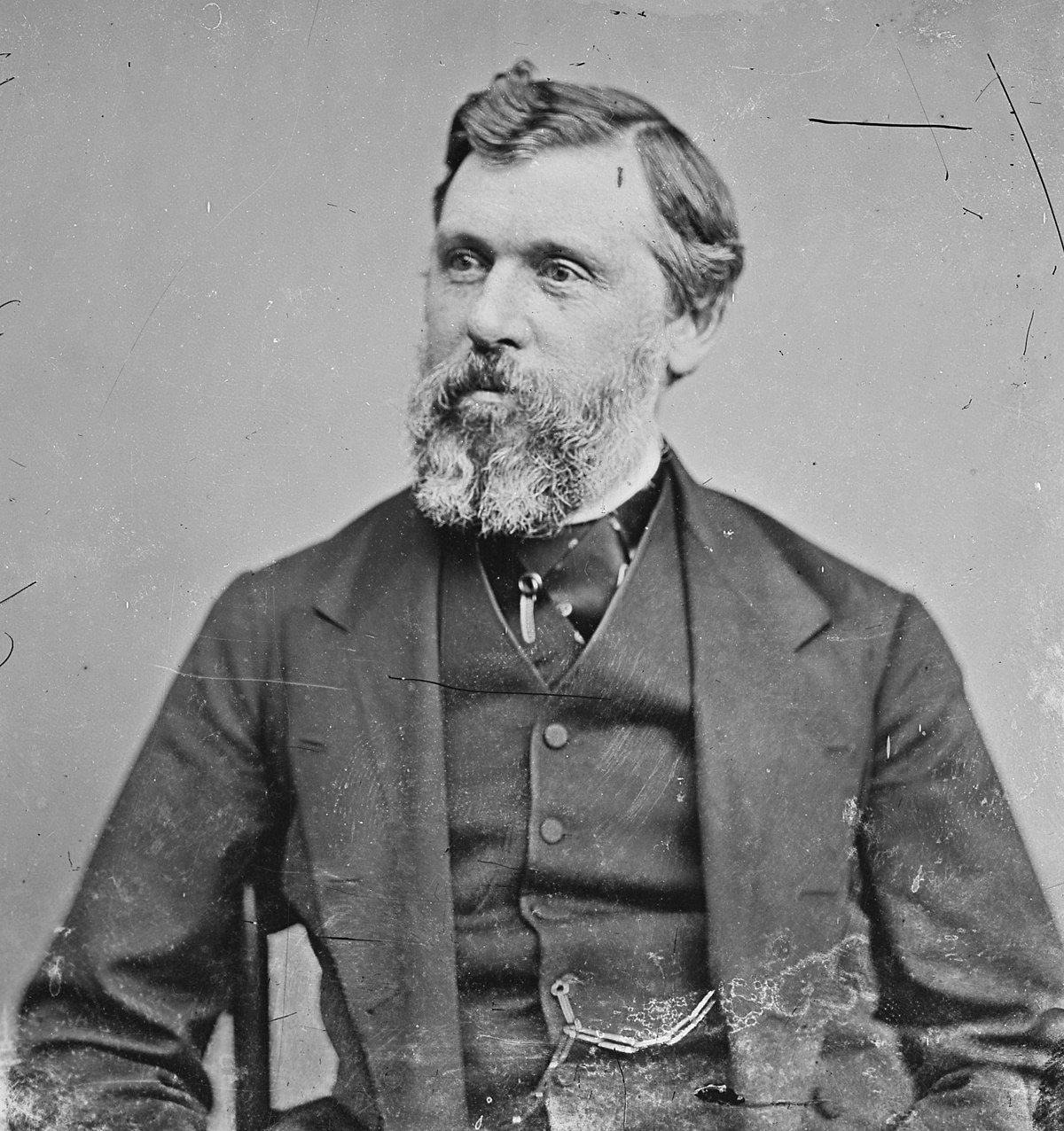
Bring me the head of J.C. Bancroft Davis!

PART TWO

Somebody stop the presses (they’re printing bullshit, anyways).

Your whole life sucks for no reason!

There’s literally, actually no basis of law that led to the fundamentally broken world you’re forced to birth your young into.  As a matter of fact, your entire existence was fucked royally sideways primarily by this man: 

That’s J.C. Bancroft Davis, but I like to call him, “you stupid fucking bastard.”

SFB, when I’m feeling cute. 

SFB here did quite a number on the future and–unconscionably–he did it on behalf of a railroad company I’m not entirely sure even exists anymore.  Good thing he wasn’t forty years later and working for GM.  As usual, I digress.

By now, I’m sure you’re shouting at the screen:  “WHAT DID HE DO?!?!”

(Just kidding; no one is reading this blog)

This SFB here created the entire American concept of corporate personhood, by himself, without consulting anyone else.  This man was not president or emperor or even ON THE SUPREME COURT.  This man–who completed his legal education only after having been once suspended, and likely only on the back of his auspicious lineage–completely altered the course of human history in his job as THE REPORTER FOR THE SUPREME COURT.  

Alright…I’m overselling it a little bit and I’ll calm down.  I’ll take a step back so we can dig into who we’re talking about here.  This fella’ has quite a pedigree.  Among the “Davis” family, this absolute mistake of nature was birthed into a dynasty with roots incestuously deep into the Whig Party, then the Federalist Party, and then the eventual Republican Party. Harvard and Yale educations have been frequent among them, and most had gone further on to law school. Some were in clubs at these schools such as the Fox Club at Harvard and one of the founding members of the Skull and Dagger secret society at Yale and Harvard shares this abjectly poisoned DNA.  Moreover, they’re directly connected by blood and by marriage to the Lodge clan, made famous by imperialist Son-of-a-Bitch, Henry Cabot Lodge.  There’s still one alive, to our collective chagrin, a George C. Lodge, who would still be inflicting this hereditary privilege upon us had he not lost a congressional election to the scion of another corrupt political dynasty, Edward Kennedy.  

So, with those congenital connections, it isn’t hard to see how this relatively inconsequential descendant of someone important would’ve floundered upwards into the corrupt administration of Ulysses S. Grant.  Grant’s administration, by the way, was so famously corrupt that it led to the rise of under secretaries in each federal department as his cronies and relatives punted and punted their jobs until someone subordinate had to be hired to do it for none of the glory.  From there, it was a quick wiggle-jaunt to get SFB into a role that would come to defy every indication that he was just another unexceptional nepo-baby and actually (arguably) the antichrist.  

In his role as Reporter for the Supreme Court, it was his unique responsibility to summarize the arguments and discussion held between justices while the court was in session.  You may wonder why this was an appointed position, and you’d be right to do so.  In the landmark case of Santa Clara County v. Southern Pacific Railroad Company (1886), the Waite court said that corporations were people.  

Except they didn’t.  Read the decision.  Not one word intentionally communicated by a justice of this nation directly invokes this notion. It only appears in the LEGALLY NON-BINDING headnote added (very conveniently) by our friend SFB.  That headnote says:

“The court does not wish to hear argument on the question whether the provision in the Fourteenth Amendment to the Constitution, which forbids a State to deny to any person within its jurisdiction the equal protection of the laws, applies to these corporations. We are all of the opinion that it does.”

That’s the editorial we, of course, because there’s never been any evidence to suggest this was anything more than a biased interpretation of pre-trial chatter.  Moreover, SFB had good reason to want the Waite court to resign themselves to this legal fiction:  Davis’s prior position as president of Newburgh and New York Railway probably made him conflicted to the point that his only interest would be selfish.  

And somehow our entire conception of the role of corporations in society was borne of a morally compromised idiot editorializing.  Mad yet?

How about if I told you that Justice Stephen Fields, whose railroad connections were manifest, plentiful, and profitable (and likely the justice whose fractiousness led to whatever discussion caused the smoking gun headnote)?  What if I told you he later flew flagrantly in the face of the rule of law and cited a headnote, which somehow had the bootstrapping effect of canonizing non-canon thought.  Angry now?

Okay, what if I told you that headnote and its subsequent corrupt invocation by Fields was the *ONLY LEGAL BASIS* for the standard of corporate personhood which allowed the Citizens United (2010) case to unrestrict and anonymize campaign donations from businesses?  The entire pitiful state of our ability to live fulfilling lives unbeholden to unexceptional white men and their fathers was sold wholeheartedly to things which pretend to be people and are implicitly not.  Imagine if it was an alien instead of your insurance provider.  Invasion of the Body Snatchers, anyone?

In case you didn’t know, here’s the 14th Amendment, emphasis mine:

AMENDMENT XIV

Section 1. All persons born or naturalized in the United States, and subject to the jurisdiction thereof, are citizens of the United States and of the State wherein they reside. No State shall make or enforce any law which shall abridge the privileges or immunities of citizens of the United States; nor shall any State deprive any person of life, liberty, or property, without due process of law; nor deny to any person within its jurisdiction the equal protection of the laws.

Section 2. Representatives shall be apportioned among the several States according to their respective numbers, counting the whole number of persons in each State, excluding Indians not taxed. But when the right to vote at any election for the choice of electors for President and Vice-President of the United States, Representatives in Congress, the Executive and Judicial officers of a State, or the members of the Legislature thereof, is denied to any of the male inhabitants of such State, being twenty-one years of age, and citizens of the United States, or in any way abridged, except for participation in rebellion, or other crime, the basis of representation therein shall be reduced in the proportion which the number of such male citizens shall bear to the whole number of male citizens twenty-one years of age in such State.

Section 3. No person shall be a Senator or Representative in Congress, or elector of President and Vice-President, or hold any office, civil or military, under the United States, or under any State, who, having previously taken an oath, as a member of Congress, or as an officer of the United States, or as a member of any State legislature, or as an executive or judicial officer of any State, to support the Constitution of the United States, shall have engaged in insurrection or rebellion against the same, or given aid or comfort to the enemies thereof. But Congress may by a vote of two-thirds of each House, remove such disability.

Section 4. The validity of the public debt of the United States, authorized by law, including debts incurred for payment of pensions and bounties for services in suppressing insurrection or rebellion, shall not be questioned. But neither the United States nor any State shall assume or pay any debt or obligation incurred in aid of insurrection or rebellion against the United States, or any claim for the loss or emancipation of any slave; but all such debts, obligations and claims shall be held illegal and void.

Section 5. The Congress shall have power to enforce, by appropriate legislation, the provisions of this article.

I’m sure those of you paying attention to the decline of Western Civilization have some familiarity with Section 2 and may even know that this was one of the Reconstruction Amendments designed to facilitate the rebirth of a nation following the Civil War.  What you may not know it does, however, occurs in the first five words.  

“All persons born or naturalized…”

In terms of legal analysis, this means the 14th amendment tells you what a person is.  At least legally.  The text of the amendment makes it clear that it is throwing the widest blanket possible across the broad spectrum of humanity.  The only two ways a person may begin to exist must then be considered in the drafting of the verbiage.  To be a person, and therefore relevant to this discussion, one must be capable of being born or naturalized.  Neither are even remotely possible for a corporation, and don’t hand me any metaphors about your “proud startup baby.”  Drown it in the bath and get back to me.  Section 1 of the 14th Amendment, if anything, should be held up as the primary example of the continued influence of enlightenment humanism on the thinkers, even some 100 years past the nation’s founding.  They believed that nothing was superior to that sentient spark some call the human soul.  That which diminishes it for the sake of order is antithetical to the rhetoric which birthed this nation and antithetical to life itself.  A railroad corporation that couldn’t even effectively manage its own finances, built its tracks with an abundance of “non-slave” slave labor, and apparently only had a talent for graft, stole your life out from under you decades before you, yourself, were born or naturalized.  

To further underscore the insanity of corporate personhood, let’s have another brief digression to establish a fundamental fact about the rule of law.  The basis for law and order is a transactional affair.  The completion of responsibilities results in the awarding of rights.  This arrangement can be implied, as in the voluntary act of NOT killing people allows you the personal freedom of not being incarcerated, or it can be explicit, like requiring registration for the draft.  In short, to be treated like a citizen (or else a person) one must act like a citizen.  Call me Kant, but you have an implicit duty not to be an asshole. Ask: If everyone did the thing you’re doing right now, would the Earth continue to spin on its axis?  No?  THEN STOP IT. 

Now, onto the thought experiment:

A big company discharges heated runoff into the river immediately behind its headquarters as an externalized cost of production.  This actually happens.  It’s why so many waterways in industrial zones have unseasonal algal blooms and fish kills.  The state of Iowa just killed all the fish in a 60 mile radius through similar offloading of externalities, for a pressing example.  The hypothetical part is this:  what if a child is swimming, absent-mindedly, and it scalded to death by the heat.  Terrible tragedy.  Awful accident.  Also 100% preventable.  In Criminal law that’s (paraphrasing) the basis for “Criminal Negligence” if not advancing to the level of “Recklessness.”  Criminal Negligence resulting in death is commonly referred to, by the way, as manslaughter.  

So we charge that company (the person) with manslaughter, correct?  

I bet that idea replaced manslaughter with man’s laughter in your head, because it’s preposterous.  How would we incarcerate it?  Which rights would we revoke for such a gross dereliction of personal responsibility?  An entity which is not a person under every aspect of the rule of law cannot be a person under any.  Mic drop.  

“So why do we uphold this?”

That’s the kind of question someone only asks if they wander in halfway through a movie.  We uphold it because the people empowered by it are also the ones impacting all the decision making.  Those undisclosed campaign donations, empowered solely by this impressive legal fiction, have installed a confused group of puppetted politicians who can do no work because they’re being pulled, as if by scared horses attached to their limbs, in countless, incongruous directions by entities which are in no way separate as a person from the soulless parasites who run them.  The era of the golden parachute is set to be replaced by the era of a legal albatross around everyone’s neck.  

The end result of this lunacy?  A spray tanned demagogue thinks the president is absolved of the legal ramifications of his morally (and financially) bankrupt decision making because, “that’s how Daddy’s company worked.”

And it’s all J.C. Bancroft Davis’ fault.  Stupid fucking bastard.  

The idea that a multinational corporation–with its boundless and immorally extracted resources, uncapped political influence, and single-minded pursuit of intangible and impossible infinite profit growth–should be treated as the legal equivalent of an individual citizen is a staggering, flummoxing, and wholly insane distortion of the principles of democracy and equality under the law.

This legal fiction is not an accident or a neutral feature of our system – it is a deliberate construct designed to benefit the wealthy and powerful at the expense of ordinary people, the world we live in, and the general appreciation for human decency as our paramount mission. By granting corporations the same rights and protections as individuals, while completely shielding the morally bankrupt who lead them from many of the responsibilities and constraints that *real* individuals face, our legal system has created a profoundly uneven playing field that tilts ever more steeply toward the interests of capital over labor.  Capital, by the way, equates to absolutely zero in a system where a fiat currency is backed exclusively by a cascading series of privately controlled debts.  

The result is a society in which the voices and needs of ordinary people are increasingly drowned out by the outsized influence of corporate power. From the corrupting influence of money in politics to the erosion of worker protections and the concentration of wealth in fewer and fewer hands, the dominance of corporate interests has led to a hollowing out of the middle class and a sense of powerlessness and disenfranchisement among large swaths of the population.  And *SOMEHOW* people stand in line and risk (justified) outrage as they hand away their life to THE badly-groomed, poorly-raised, impossibly coiffured scion of this horrific and impossible system.  

However, our baleful ex-president is not indicative of a new phenomenon, nor is he its originator – it is the latest iteration of a long history of exploitation and dispossession, from the plantations of the antebellum South to the sharecropping system that replaced slavery, to the hundred years of letting immigrants build our world and Klansmen legislate their lives to nothing.  The current era of globalization and outsourcing was supposed to open up competition to its most democratic state, and all it has done is increased shareholder value and the rate of stock buybacks.  The system is sick, and the current buffoon and his terrified pack of mindless followers are merely a tumor restricting the essential blood flow of justice to all people.  

While the methods may nominally change, the underlying dynamic remains the same – a system that privileges the interests of the few over the many, and that treats human beings as little more than inputs to be exploited for profit.  Profit which (AGAIN, FOR THE CHEAP SEATS) means literally nothing when the universal debt burden across the geopolitical spectrum has 100% of the world constantly in arrears with one another.  Profit value which does not trickle anywhere, despite the creation of actual worth being exclusively the purview of those “menial” workers deprived a living wage so people like miserable shitbag Steve Huffman can deface free speech, quash ‘free’ competition, rely solely on free labor, and *STILL* award himself a totally fictional 193 Million Dollars in compensation.  Like J.C. Bancroft Davis, that’s one massive SBF.  

To challenge this system and build a more just and equitable society, we need to fundamentally rethink the relationship between corporations and people. Primarily, we need to recognize that corporations are not people, and that their rights and privileges must be subordinate to the needs and well-being of actual human beings.  I don’t have any fucking clue why that’s so hard to understand.  If your workers all go home, you do not have a corporation.  How in the hell can we create a country “for the people, of the people, and by the people,” and then sell it immediately to the ethically handicapped who fail to separate the entity from the creatures which comprise said entity.  Paradoxically, they missed the trees for the forest and therefore didn’t notice when that forest became four or five unnecessarily large trees.  Where then is the shade in which the forest dwellers are to live?  It’s such an incredible failure of anything resembling logic that I am almost frothing at the mouth as I hammer these keys and feel the walls of my cubicle threatening to bludgeon me to death. 

There will be a radical restructuring of our legal and political institutions, or there will be an end to things; an incredible bang followed by a long, miserable whimper into nothingness.  Ensuring that the voices and interests of ordinary people are not just heard, but prioritized and protected, is the only means by which progress can be achieved.  It will require a renewed commitment to the values of democracy, equality, and solidarity, and a willingness to challenge the entrenched power of corporate interests, as well as the general understanding of how corporations are antithetical to anything resembling “freedom”–whether of the market or otherwise.  

Only by reclaiming the idea of personhood as a fundamentally human attribute, rather than a legal fiction to be exploited by the wealthy and powerful, can we hope to build a society in which the dignity and worth of every individual is truly respected and upheld.

From Hell, 

–The Strangest

(P.S. To James Bopp, Jr., to Steve Huffman, and to J.C. Bancroft Davis–I’ll be over at the unwed mother spitroast with Hitler and Joseph Smith when you get down here.  Wear sunscreen.  It’s a scorcher.)

“Hey, this snake is eating my tail, too!”: American Faux-Capitalism & You

PART ONE

If you’ve kept up with these radical ramblings for these past few weeks, you may have incorrectly arrived at the conclusion that my sole purpose in life is to dismantle the capitalist system like some kind of idiot child who missed the moral at the end of Aesop’s “Lenin, Stalin, and Trotsky do Marx.”  

Let me be abundantly clear:  I am not here to tell you (or anyone else) that they cannot be capitalists.  I’m here to tell you that this isn’t capitalism.  

Alright, boys and girls, who can tell me where capitalism comes from?

And it isn’t when a mommy businessman and a daddy businessman hate each other very much and start rival businesses.  

The idea is (arguably) the brainchild of Adam Smith, who wrote, “An Inquiry into the Nature and Causes of the Wealth of Nations” in 1776.  Perhaps it’s unsurprising, given the portentous year, that the new American Experiment would become enamored with the Scottish thinker who could rightly be called the precursor to all academic thought on the topic of economics.  The prevailing economic theories of his time were manifestly bad for human beings.  The first was Mercantilism, borne of the medieval guilds of tradesmen and dragged awkwardly into the era of the Enlightenment by wealth that was difficult to displace.  The other was the theory of “God’s Will” driving the distribution of that wealth.  While the second point is easier to dispute without deep thought, the former merits further clarification.  Mercantilism is the end result of the market unduly influencing the various columns of the estate.  More expansively (and courtesy of Wikimedia’s permissive use policies):

“Mercantilism is a nationalist economic policy that is designed to maximize the exports and minimize the imports for an economy. In other words, it seeks to maximize the accumulation of resources within the country and use those resources for one-sided trade.

The policy aims to reduce a possible current account deficit or reach a current account surplus, and it includes measures aimed at accumulating monetary reserves by a positive balance of trade, especially of finished goods. Historically, such policies might have contributed to war and motivated colonial expansion. Mercantilist theory varies in sophistication from one writer to another and has evolved over time.

Mercantilism promotes government regulation of a nation’s economy for the purpose of augmenting and bolstering state power at the expense of rival national powers.”

Most proud capitalists would beat their chests with pride to read that they proudly represent a modern system dedicated to dismantling these horrible government overreaches.  I’d be right there with you.  As a matter of fact, I am.  I’m actively upset by our modern economic policy which is the most mercantilist of any developed nation and which has supplanted “God’s Will” with a lazy mutant offspring of Social Darwinism as its backbone.  

Adam Smith’s positions can be aligned loosely around five “poles.”  These are the areas of the prevailing mercantilism which he believed to be most in need of correction.  They are:

  1. Economic inefficiency of mercantilism: Smith criticized the prevailing economic system of mercantilism, which emphasized state control, trade restrictions, and the accumulation of gold and silver. He argued that this system led to inefficiencies and hindered economic growth.
  2. Limited understanding of market dynamics: Before Smith, there was a lack of comprehensive understanding of how markets operate. Smith sought to explain how individuals acting in their own self-interest could lead to overall economic benefits for society.
  3. Role of government intervention: Smith questioned the necessity and effectiveness of extensive government intervention in the economy. He argued that the “invisible hand” of the market, driven by self-interest and competition, could regulate the economy more efficiently than government policies.
  4. Division of labor and specialization: Smith recognized the importance of the division of labor and specialization in increasing productivity and economic growth. He used this concept to support his argument for free trade and the benefits of larger markets.
  5. Free trade and international commerce: Smith advocated for free trade and the reduction of trade barriers between nations. He believed that free trade would lead to increased competition, lower prices, and greater economic prosperity for all countries involved.

Consequently, every supposed capitalist picks one or two of these talking points from a grab bag and warps their intention until they can justify the Starbucks they’re putting next to the other Starbucks, across from the Panera, down the street from Caribou Coffee.  An as-yet unmentioned and fundamental aspect of Smith’s thinking, which I’ve left out now for dramatic effect–and I welcome you to gasp audibly–is that the role of the government is to establish the equal playing field necessary for a market to be “free.”  

I don’t know if you knew this, but it’s nearly impossible to win a race when you’re asked to start half-a-lap behind everyone else.  There are edge cases to refute this thinking.  Usain Bolt, in his peak, maybe.  However, the sheer reality is that second and third place would be unduly enriched to the point that everyone’s competition is invalidated.  Apply that same logic to the last spoiled, nepo-brat you chatted with and tell me if you feel like the market is actually “free.”

But I’m getting ahead of myself.  Let’s jump back to where this capitalist train got knocked askew and plowed into the basic premise of human decency with all the insight of a mole optometrist.  

For reasons other than a jingoistic American perspective, 1776 was something of a major year for the globe.  From the dawn of the Age of Exploration until then, human beings had been undertaking a policy of colonial imperialism that breached the surly bonds of morality and snowballed rapidly into extractionist resource management and the advent of the chattel slavery system.  Now there was a country to embody that gross ethos for them.  By engaging with the USA, countries all over the world could now hold onto their cake and eat yours.  For the next nearly 100 years, the developed world had absolutely no qualms about either–in no small part due to the fact that the boots-on-the-ground beneficiaries in the Western World had little cause to question from where their newfound luxuries had come.  The period between the French Revolution and the American Civil War was famous for many things, but the advent of critical journalism as the fourth estate is perhaps the most enduring.  As writers turned their attention to the pernicious evils endemic to this misappropriation of Smith’s work, the public became less willing to engage in the system.  To combat that, some genuinely vile thinkers turned to the also-new scientific discoveries of one Charles Darwin to suggest that whereas “God” had given them their wealth, historically, it was now being delivered to them because the “heathens” from whom wealth was being stolen were “inferior.”  

Can you imagine a more winning strategy than telling people they deserve things because they are intrinsically better than someone else?  Nothing you or God could ever do would change the fact that, “some people are slaves because they can’t be anything else.”  Creating a “chosen people” is a fundamental fascist practice.  In that case, it’s often nationalism.  In America’s case, it was something even further removed from reality.  Instead of the already-nebulous concept of borderlines, we began to rank and score people based upon the accrual of fiat currency.  There was now a physical scrip the oligarchs above us could dole out to show which people were chosen and which people were not.  It’s unsurprising that most of these benefits only ever extended to people who looked and felt like those in power, already.  

The first time a human being was imported to the New World as property, we moved one step further away from the Free Market of Smith’s devising.  The natural flow of resources and specialization had been staunched by several thousand wealthy, white, landed gentry-men.  The market was approximately as free as the US Population in 1860, where both Mississippi and South Carolina had enslaved populations making up more than half of the total population.  55.2% and 57.2%, respectively, if you were curious.  

So, I’m sure the freeing of the slaves probably fixed that, though, right?  Since 1900, at least, we’ve been living in the free market, right?  

Wrong-O.  

We still had several issues to work out.  You may have heard of them:  Child Labor, unequal suffrage, the general disenfranchisement of women, and the continued accrual of most wealth in the hands of who used to be the slave-holding elite (who were not punished severely enough during the Reconstruction era) and burgeoning Northern industrial dynasties.  Furthermore, when the slave labor dried up, we took to the habit of calling for the “tired, the poor, the huddled masses” so they could be indentured as wage slaves and maligned by the emergent KKK, who took their faux-Darwinist exceptionalism to a fundamentally untenable extreme.  What wasn’t cheap immigrant labor was made up of sharecroppers and badly provided-for freedmen who took whatever unequal contractual terms they could get.  

Part and parcel of the corporate monstrosity is the capacity for infinite rebranding.  The emperor only has to be naked for a second before he’s, “empowering the human body by demonstration” and then suddenly a shadily-funded congressional edict comes down demanding everyone take off their clothes.  

The voices that needed change were so effectively quashed as to make the zeitgeist of the moment gilded.  A thin foil of something luminous around a rotten core of toxic, radioactive shit.  The accelerating snowball of oppression was reaching critical mass.  The great pyramid scheme had been perfected, and the creation of another marginally costless workforce was the only way to keep it going.  I’ve talked about that before, and won’t bore you again with the details, now (read the earlier post “Dawn of the Digital Plantation” for more on that).  Somehow, in the intervening hundred-plus years, we managed to repaint and rebrand the same kind of injustice over and over until we became numb to the torment.  

The original description of this economic system was called what? 

“Trickle down economics!”

Incorrect.  That’s some Hoover-and-Reaganomics rebranding; part of one of the most effective propaganda campaigns in the modern era.  They didn’t elect a president, they cast one from the backlots of middling Westerns.  The power of calling someone a “welfare queen” is amplified ten-million-fold when a handsome cowboy ‘awh-shucks’ his way through it.  Back to the original point, muckraking (read: noble & justified) journalists of the late 19th and early 20th centuries called this economic system “Oat-and-Sparrow” economics.  Why is that?  Well, if you feed all of your oats to a horse, he’s unlikely to digest all that insoluble fiber.  I’m sure he’ll leave some behind in scat piles for the sparrows to pick at.  

Are you satisfied with your life picking through Musk and Bezos’ shit for the oats to feed your family?  How about with your stagnant wages and growing tax and interest burdens?  Does it bother you to experience both while multinational corporations receive massive subsidies, government bailouts, and whose executives are collectively responsible for $160 billion dollars in annual tax delinquency?  

Capitalism, in Smith’s original postulation, is not presented as a panacea.  Human incapacity for nuance turned, “this is a nice way to get more things for less money,” into, “why don’t we decide who eats and who doesn’t this way?”  Capitalism is not God.  It isn’t even a little-g god.  It only solves the issue of non-essential resource allocation.  It does not exist in a vacuum or in a position superior to moral reasoning.  As a matter of fact, Smith lays out some pretty simple parameters to the contrary.  While he did advocate for a laissez-faire approach in the sense of limited government intervention in the workings of the market, he also recognized the importance of certain government actions in creating a level playing field.

In “The Wealth of Nations,” (and again–the text that BIRTHED CAPITALISM) Smith argued that the government had a responsibility to provide certain public goods and services, such as education, infrastructure, and a legal system that enforces contracts and property rights. These provisions were seen as necessary to ensure that individuals could participate in the market on a more equal footing.  Almost as if a free market can only exist in a fundamentally free society.  Voluntary association is the foremost tentpole of Smith’s original reckoning and, much like the early church abandoning the individualistic bent of the Gnostic texts, the parts of the ethos which empowered all people were neutered and discarded.  

However, it’s important to note that Smith’s views on equality were shaped by the context of his time. I don’t want to provide the illusion that any great thinker should be considered a proud icon solely by virtue of his critical thinking skills.  Good ideas do not always translate to good men, generally.  For instance, among the great thinkers responsible for what little actual freedom there is in the Western World, Jean-Jacques Rousseau’s Social Contract is a boon to all mankind; his running, bare-assed in the street at women in hopes of an errant spank was not (look it up).  You are not required to be a paragon of virtue to be virtuous.  We are all an amalgam of the society which spawns us, and it’s hard to recognize that without the benefit of hindsight.  Judge not, lest ye be judged.  Going back beyond Smith himself, and regardless of anything else he ever did, his work’s primary focus was on removing artificial barriers to economic participation, such as monopolies and trade restrictions, which he saw as benefiting a select few at the expense of the general population. He believed that by removing these barriers and promoting free competition, individuals would have greater opportunities to improve their economic standing.  Full stop.

Which part of that sounds like the economy you live in?  

Social mobility is a myth perpetuated by the oligarchs who consume our lives as an excuse for when they find another unindicted co-conspirator to elevate to their parasitic equal.  Wealth is still distributed pursuant to “God’s Will,” we’ve merely traded in our gods for shitty, little, middle-aged men and their insulating field of cronies and bought politicians.  We let the wolf in sheep’s clothing pilfer the larder and run off with the flock.  He lends them back to us at a premium that increases annually for no reason at all.  At which point does human life become the commodity being traded back and forth in these shadowy backroom handshakes?  How many scores of human beings were entirely cut out of the economic picture during greased palm passing on board the Lolita Express?  This kind of wilful corruption is also evident in the increasing government-sponsored monopolization of key industries and services.

Name a search engine you used today that wasn’t Google.  Did you order something from anything *other* than Amazon, lately?  How about that really great array of affordable electric cars you have to pick from?  

The human capability to rationalize our own bad actions is almost impressive in its capacity to absolve oneself of wrongdoing.  Our willingness to rationalize the bad actions of others is a preposterous evolution of that concept.  It’s time we stopped justifying bad actors for the promise of eventual progress.  The ‘progress’ they promise is wildly unequal and it’s high time we stop supporting nefarious regimes out of complacency.  As much as I hate the reductio-ad-Nazism trend in modern rhetoric, it’s hard to pick a better illustration than the road to Bergen-Belsen being paved by apathy to injustice which does not impact you directly–at least not today.  The general trend in history is that if you do not stand up for others, there will be no one left to stand up for you when the spotlight of kleptocracy finally deigns to cross your path.  

So when you look at a political candidate, supposedly the face of capitalism, and you see that he received 100% of his fortune via inheritance and has made nothing of it–raise your eyebrows.  When the “strongest economy on Earth” is propped up with insane tariffs and anticompetitive practices, alongside a long track record of war profiteering as a national pastime–raise your eyebrows.  When campaign donations are undisclosed and unlimited–raise your eyebrows.  

Most of the things you supposed-capitalists are asking for would be the death of the free market and of what modicum of freedom and social mobility to the refusal of mercantilism allowed us, once upon a time.  

It’s time we reclaim our own economy, which is of and by the people, to be for them once again.  We’ve built empires solely with the power of outsourcing our externalities.  Whether by extracting resources elsewhere or by diminishing the populace of another place to create a marginally-cost-free workforce, we have made sure the only thing in our backyard is the above ground pool and truck on blocks. 

I ask you to resist that impulse; to consider the miseries endemic to the trappings of pitiful luxury that have trickled down to you as a pale, cheap imitation of something for your “betters.”  To build a functional democracy, we have to build it back in that neglected backyard.  Competition between equals takes place at a local level, removed from the concept of multinational chains and unchallenged mergers and acquisitions.  The individual is not supposed to be a data point amid millions; the individual is meant to be the primary unit of society in a civilization structured from the ground up, as a collection of independently operable and sustainable cells.  

Until the eventual catastrophic reckoning (whatever it is; I’m betting climate change), all you can do is start small.  Pay attention to your local elections.  Get to know the difference between a right and a responsibility.  Take on the latter to acquire the former.  Stop shopping big box until the government offers the same subsidies the big boys get to your mom and pop shop.  Resist the ongoing urge to grow infinitely and grow intimately, in a way that empowers the world immediately around you.  If everyone’s backyard is in order, purview entirely to their efforts and their efforts alone, the entire world becomes a quilt of beautiful squares.  

From Hell,

–The Strangest

Source Decay

You’ve lived your life, whether you know it or not, gripped by the fear of a myth.  In much the same way someone aquake with the prospect of Sasquatch might be looked down upon, perhaps it’s time to look down upon the uninsightful myriad who perpetuate the false notion that scarcity has to be part of the human condition in the year 2024.  

I’ve been told that the world is getting better.  This message is usually communicated by the idea that people are living longer and everyone is increasingly equal in the eyes of the giant organizations and institutions that bat them about as data points.  As much as I’d like to really dig into the various statistical reasons that both of those are intentionally misleading figures, I’ll suffice the digression with this:  “Tell me what numbers you want, and I’ll find you the sample audience that feels that way.”

I want to talk about whether or not the world is getting better, with my boots on the ground.  Someone just starved to death in Africa.  Someone else just decapitated his unfaithful wife in Indonesia.  Forty-eight-gajillion dollars in goods are being stolen and traded and swapped and stolen again.  We treat each and every one of these incidents as isolated disruptions in the stream.  We actively choose to ignore the negative space between these conclusions that suggests something considerably more pernicious and universal.  Every time one of these tragedies occurs, we punish the action and not the system which created the action.  

Limited exclusively in the hands of 1% of the global population is the power and means necessary to literally absolve the world of physical need.  The only thing preventing that is the time they all spend at each other’s throats, creating competition where none exists in order to satisfying that aching place in their spirit which correctly identifies them as essentially unspectacular when set against the enormity of the species and the infinite span of geologic time.  

I often hear competition touted as the only means to founder innovation, but I struggle to see the forty-thousand inedible flavors of an ubiquitous sandwich cookie as innovation.  Competition certainly breeds more ‘stuff,’ but it has bred ‘stuff’ which is actively antithetical to improving the universal human experience.  Any ‘innovation’ resulting in the proliferation of automobiles was obviously less interested in improvement and much more interested in maximizing the most selfish impulses of human beings, now confined to environmentally catastrophic machines that increase the individual footprint to SUV size.  Competition, as always, gratifies the friends and cronies of those winning and destroys the soul of the thing by demanding it be made cheaper and more plentiful until it becomes simultaneously indispensable and worthless.  Competition created a human existence which is, more or less, a subscription to a wan form of brand-powered life.  

And the vision that set the snowball to rolling is dead.  The odds that *your* direct supervisor founded the business for which you work is an increasingly unlikely prospect, as your jaded, millennial middle manager doing his best Jordan Belmont impersonation is merely a cog in a greater bureaucratic machine.  Worse than that, however, is that even the C-suite of most companies had little to do with their founding, any longer.  We created a series of amorphous, cancerous masses of capital.  Whatever dynamism is required to found a business venture is capped and snuffed by the passage of time, either when a small business is cannibalized by a larger one threatened by its product or when founders pass on and are replaced by the pale facsimiles found in their ingrate nepo-babies and brown-nosed cronies.  So the process becomes the point and an ethos of creating a problem to sell a solution enamors the executive class with the idea of activity instead of action–to dance as fast as they can to prevent anyone from noticing how naked the emperor seems.  

Then they’re too big to fail and swaddled so closely in the quietly-spoken trappings of socialism which they pay corporate-friendly politicians to decry when implemented for the common person.  These great beasts, borne on the backs of a paycheck-to-paycheck nation, are the unique beneficiary of bailout after bailout, despite their predatory business practices being directly related to the dire pendulousness of our economic state.  Immoral wealth disparities and the weaponization of debt has replaced social contact in an era where investment in society is wholly being stifled by society’s complete lack of interest in reciprocal investment in its populace. Your value in the social hegemony we all choose daily to perpetuate is determined by someone who has progressively less idea what you do for them aside from, “keeping them on top of the pile.”  Data models require data points and rendering a human to a data point requires the debasement of all their essential humanity.  The advent of AI is yet another weapon in the tyrant’s arsenal, as they require fewer and fewer essential workers to analyze and enact their distant directives. When an AI manager handles operations for an automated manufacturing system, where then do all these people go?


We have reached a point in our history where it is vital for the government to perform its role as the guardian of the people from undue burden.  Many industries have become dominated wholly by conglomerates with incestuous, intermingled boards.  They have become hydra-headed monsters reaching well beyond state lines, often in flagrant violation of antitrust and anticompetition law.  If not always the letter, then certainly the spirit. There is a solution to this problem which has been successfully undertaken many times in Europe wherein these companies which have become “too big to fail” are nationalized, corrected, and set back to work with better leadership once the damage has been corrected.  I vote that America takes this a step further and reduces all business to none-larger-than regional.  If Amazon is dead set on operating universally, they still must incorporate and enact itself as a confederation of smaller scale enterprises more tuned to the populations they serve.  Any business of a sufficient size becomes, in itself, ‘government.’  It is preposterous to allow seditious, anti-human governments to continue to coexist within our borders when they do so to the explicit detriment of our own representative democracy.  They must be reduced to their proper place in the social order, where they serve their clients, customers, and workers instead of some vague notion of “infinite growth.”  No institution, given such control over the modern lifestyle, should attempt to meet every need for every person.  Our population outpaced that style of leadership many moons ago.  “Of the people, by the people, and for the people” is not a marketing slogan; it is the groundwater of democracy.  At the level which human beings are viewed by these multinational leviathans, at the macroscopic height, the people look like bits and bytes to be shuffled and reshuffled until the results come up how they’d like them.  

Allow me to preempt your rebuttal:

“These are complex, systemic challenges with no easy answers. Heavy-handed government intervention and constraints on corporate scale risk stifling economic dynamism and growth. Open competition, even if imperfect, is still the best system for allocating resources and spurring innovation.”

Anyone who thinks “open competition” exists in a world where A) the inheritance system does little to claw back undue benefits from the unexceptional children of the vaguely exceptional businessman and B) the largest companies, headed up by some of the most devout conservatives and free-market proponents, are the recipients of a disproportionate array of subsidies and handouts which prop up their anti-humanist proliferation.  The former is feudal; the latter is socialist (though lopsidedly benefitting the vague “individual” notion of corporate personhood).  The idea that a corporation is an entity making decisions outside its leadership and culture is a brilliant move in protectionist legislation and in propaganda.  Dismantling corporate personhood is the first step towards clawing back human decency from the grasp of foolish fiduciary responsibility.  When companies are “fined” and “penalized,” it does nothing to correct the corrupt wellspring of that malfeasance.  Until we corner those oligarchs as they are–as parasites abusing a system they’ve sculpted like a warped bonsai–we will be unable to rectify our grand failures as a species.  

Another rebuttal:

“The dramatic reduction in extreme poverty in China over the past few decades is directly related to the expansion of their free market system. According to World Bank data, in 1990 there were over 750 million people in China living below the international poverty line of $1.90 per day (adjusted for purchasing power parity). By 2015, that number had fallen to less than 10 million.”

On top of the issue that cherry picking statistics causes in a discussion, let’s compare this to something more tangible.  The international poverty line hovers around $2.00 a day.  That, alone, should cause most people to wretch violently.  But let’s quell the urge to spew and consider even further–there are still *10 million people who are not making more than $2.00 a day.*  Any system which allows that to happen is bad enough but one who allows it to happen while the wealthiest of our society loose the surly bonds of morality and ethics and use their extravagant wealth to peer behind the veil of good taste into depravity unbecoming.  10,000,000 people made less than $2.00, today, while Bryan Johnson, 45-year old ‘tech tycoon,’ spends incalculable sums taking blood from his son to inject into his own veins in some vain and foolish pursuit to “reverse his aging.”  What would have once been viewed as heavy-handed ‘eat the rich’ satire is literally occurring and no one is doing anything to stop it. 

The joy of it is that they only *want* you to feel trapped by it.  Anyone who tells you to “accept the things you cannot change” is not demonstrating wisdom.  They are demonstrating a complete lack of imagination.  

From Hell,

–The Strangest 

Poems and a Story from the Edge of the Abyss

Odes to the Void:

I. 

The warm smell of bad coffee

mingles mindlessly with the

maddening crackle of permanent

white noise machines

to underscore the fact that

this is someone else’s reality

and you’re merely being forced

–like a sharecropper–

to prop it up and play along.  

The expectation of humanity

in the workplace

is increasingly like

looking for gold in a uranium mine

and hoping the fortune finds you

before the cancer.

The expectation of humanity

outside the workplace

is a fool’s errand

resulting most often in death,

of the body of the soul and

of the dreams that nourish them both.  

The void calls in mellifluous tongues

from some place I can’t discern

and the clarion call of dull static

erupting ceaselessly from the

speaker above my head

nudges me closer.  

Sartre’s hell pales to the level just below it:

Hell is the people you work for.

~~~ 

II.

Somewhere, there’s a lifeboat

without an occupant

as I grasp askance at tides

and recoil at what brushes

against my legs in the abyss.

I’d taken stock of the sinking ship

with the equanimity of a drunk

and the awareness of that drunk’s

disinterested support system.  

I elected to do nothing.  

And I watched the women and children

clinging to one another, weeping;

But there was still liquor in the ice, so

I asked the dance band for a lively one

to drown out the dying

The captain’s revolver is at his temple

and the crew is playing taps over

the waterlogged corpses of their kinsmen

The water rushes in, the deck splits,

and I realize there’s no one left to die with.

So I leap into the water,

grown ugly and whitecapped 

in my inattention

and notice little makeshift vessels

where they’ve already resorted

to cannibalism.  

May the dark deep well of the ocean wash us all clean.  

~~~

III.

It’s 9:21 on a Monday morning

and I’m already out of things to do

except stare at the blank page

and try to codify the maelstrom of my mind

(the tempest in a teapot)

into something more closely resembling

shouting madness into a drainage culvert

to comfort in the return call of an echo.  

Between A and Z is the weight and sum

of human expression;

and in that primordial soup of thought

lies an essential truth.  

Like some code in an airport novel,

the life of the mind is one of 

parsing right from wrong

until all that is left is one, true sentence.  

There are false positives.  

There are wars and crucifixions,

all on the proliferation of unreal truth.  

The destination became the journey

as invective became the whole measure

and invention became a byproduct of

the end and the dying.  

What truth there may be,

if there may be,

Is highly unlikely to amount to:

“Mexicans, go to hell.”

~~~

IV.

At the bottom of my soul,

which feels to be wedged in too-small

space between my heart and lungs,

there is a black, cancerous mass

which seems unlikely to metastasize

and contents itself with a death

by one million cuts.  

I feel the pressure of knowing

pressing at the seams of my skull

and threatening to spill out

the well of vitriol and venom

that mutated into the gnawing,

tumescent sickness of aura.  

The eventual escape of death

is merely another symptom

of the malady, carried congenitally

by the last, gasping breaths of empire.

Millions will rise to replace you;

and nothing you were born to do

matters to anyone else.  

The villainy and the tyranny

come part and parcel

the cruelty and the crassness

endemic. I hope our last hacking cough

is a miserable one

and that those who live to see it

in their billion dollar bunkers

finally fulfill their ouroboroan destiny

when the luxury food runs out.   

America (or: the unexpected virtue of virtuelessness)

The match wouldn’t strike on the wet flint strip, the tarp roof had a tear that was becoming a skylight, and the thick carpet of mold implied his food wasn’t going to carry him any further.  The little cartoon songbirds fluttered around his head and faces appeared and disappeared in the shortening light of an oncoming night below freezing.  Sam closed his eyes tight and rocked until he found the rhythm that shook them all away.  Even still, shadowy figures danced in and out of his periphery, whispering to one another about him.  Sam couldn’t make out exactly what they were saying, but he felt in his heart they were laughing at him.  Laughing at how he can’t even take care of himself.  Making fun of the way he can’t keep a job and how everyone he knows thinks he’s a dangerous nutcase.  Snickering about how pathetic he is.  

He closed his eyes again and pressed the heels of his palms into them until green and blue flashes crash and scatter like a thunderstorm out past the ocean’s horizon.  He presses until it hurts, happy to see things he knows he can control and things he knows are at least a little bit real.  The mist was becoming a drizzle and hopefully just became rain.  Sleet would cave the ramshackle tent immediately in on itself.  Sam didn’t have anywhere else to go.  Even in the shelter, he can’t afford his medicine, and the shelters never let him stay when they realize what’s wrong with him.  They can’t take on the liability, they say, and they try to have him taken back to the other place.  He can’t go back there.  Some people say he just won’t, but he can’t.  

Thinking about the other place makes flashes of blood and guts appear and disappear in his head.  He hears words like ‘meat’ and ‘bone.’  Sam doesn’t hurt people, but sometimes he’s afraid he might.  

The drizzle was then rain, and he could see it starting to glaze over into a slushy frost in the potholes on the blacktop.  His teeth chattered in morse code, communicating messages of comfort from God.  God would swallow him up and hold him.  God didn’t talk to him much, anymore, and he was worried he had disappointed him.  

That’s what Sam was thinking about when he froze to death under a torn blue tarp, stiff with ice.  

Thirty-six floors above him, Jeff Bezos shot a hot wad of cum from a chemically assisted hardon into his mostly-synthetic fiancee on a $2500-a-night hotel bed.  He was basking in the afterglow, thinking about ordering half a grapefruit and how cool it was when he wore that cowboy hat to space.  He wished the sirens outside would calm the fuck down.  The only voice he heard in his head was his own, telling him what a fucking superstar he was.  

Dawn of the Digital Plantation

There’s something considerably more terrifying than Romero’s dead shambling over the horizon.  It’s a brand new slave class, courtesy of approximately 50 years of intermittently successful research into artificial intelligence.  

Perhaps the strongest piece of evidence in the continual assessment of whether or not human beings have an inborn inclination towards morality or immorality is the fact that, despite several attempts to alter our behavior grandly, human progress until now has been more or less entirely dependant upon indentured labor and the systemic subjugation of a large subset of the population underneath some much smaller and more nefarious group.  

While literal chattel slavery has been decreasing in attractiveness in the developed world for some 400 years, those wily autocrats never fail to recreate the system by measures and by shades in the economic vacuum left by the complete dissolution of a labor force which marginally costs zero.  Even in the supposed democratic powerhouse from which this piece is being written, the wheels of commerce would grind to a halt without a powerful combination of 1) undocumented labor, 2) Outsourced sweatshop labor, and 3) labor which is paid well below living wage, creating an endemic system of need not unlike the disenfranchising practices utilized against freedmen sharecroppers during the Reconstruction Era.  Thus, it is with no small measure of fanfare that the fledgling AI revolution has been heralded as an end to menial labor.  While I lack the longitudinal perspective necessary to debate the relative morality of creating something arguably intelligent solely for the purpose of subjugating it, I have enough human experience to state–unequivocally–that ‘the end of menial labor’ will do approximately zero to alleviate human suffering unless proactive steps are taken to minimize the externalities congenital to the birth of an infinitely cheap, massively pliable slave class which can be comfortably housed in the cloud.  

If we know, for a demonstrated fact, that unemployed and unhoused human beings are not a primary concern of the wealthy oligarchs who marionette their puppet government through the legislated graft of lobbying, then it would be preposterous to expect any consideration for the remaining dregs of an erased middle class absolutely set to be cannibalized by a corporate world hungry for this mythical digital labor force incapable of collective bargaining.  The high barriers to economic independence are already made higher by a hegemonic crippling of social mobility.  Do we dare imagine a world where these new corporate gentry are no longer even  remotely beholden to the cries of ‘mere mortals’ as their indispensable workforce is made entirely of digital artiface? 

Do I dare to eat a peach?    

Without careful consideration, the rapid adoption of AI among the corporate world could be a bigger blow to democracy than the evolution and adoption of the world wide web and its subsequent dot-com boom which worked in tandem to delegitimize dreams of fiber optic freedom.  We replaced them with kitschy amusement parks for business interests.  To borrow a quote from my favorite fictional author:  “The internet was supposed to set us free, democratize us, but all it’s really given us is Howard Dean’s aborted candidacy and 24-hour-a-day access to kiddie porn.”

The glib wisdom of Hank Moody aside, it’s difficult to imagine explaining to those who were there at its inception that the internet itself would grow into a tool for mass manipulation and the transmission of corporate-and-consumer messages to the masses.  As a matter of fact, it’s apparent that it didn’t occur to them, as it was released into the wild where it supplanted a natural sociological food web with a soulless internet of things in which average citizens are merely a small and inconsequential data point to be rearranged ad nauseum at the whims of daytrading masses.  How is it, in a world and a nation where the individual is continually connected to every other individual by this invisible lasso of gigs and bits, that our self-limited American democracy has become less direct, more capricious, and less involved in improving the daily individual experience of most of its populace?

Yet here we are again, at the precipice of technological change, which our species has continually failed to culturally or intellectually advance in pace with since the discovery of long-term, preserved food storage.  Since the dawn of civilization, mankind has often held the tools necessary to advance itself holistically, and chosen instead to exploit mindlessly its many gifts.  The human being, left in a moral vacuum, has the natural tendency to act as an agent of general entropy and decay.  As an electrical current follows Ohm’s Law through the path of least resistance, so too does a person follow its biological equivalent past good taste and into the depravity of selfishness.  

The central human myths, globally, share some version of a particular story that is arguably the most ubiquitous.  Pandora opens the box; someone eats an apple and puts on pants.  Our capacity to want more than we are afforded is the core component of the monomyth.  We are acutely aware of our capacity for avarice to the point of our own undoing and have been since the dawn of recorded history.  The story of the human experience is one of evolution curtailed and warped by the wilful ignorance of our fatal flaw.  Whether or not you’d like to blame how cool Michael Douglas is, personally, it’s ever apparent that the postmodern era has been beset almost entirely by a grotesque predilection towards embracing those greedy, ratlike tendencies.  

We pride ourselves on our capacity for evolution; that human beings are infinitely adaptable by virtue of whatever combination of higher order thinking aggregates to ‘sentience.’  Yet, we change precious little.  We are apes clubbing one another, championing might making right, with the only thing that really changes being the size and the shape of the weapons we use.  It would stand to reason, after centuries of being clubbed by physically stronger apes, someone would use that wily higher order thinking to redefine ‘might’ along terms wherein even the most unexceptional can flourish.  Accrual of a fiat currency is a great way to claim might without due cause or associated benefit to society.  For several centuries, that dark wrinkle of the American Experiment has been innocuous enough to be swallowed.  The dissolved Occupy Wall Street movement was an immature stroke at addressing the issue, drowned in its infancy by the powerful pro-corporate propaganda machine of Big Media and its corrupted Fourth Estate power.  Only now, as this new wave of AI implementation threatens the scattered remnants of a middle-managing middle-class, has the public become anxious and conscious of an impending reality where baseline humans are separated by an enslaved and digital middle class from the executive echelons where the American Dream takes on a corpulent bent.  I only hope it is not too late to uproot the sinister infiltration of corporate interests into the groundwater of our still-young nation.  

The executive-elite are removed enough from the work you do for them to consider anything done by anyone else ‘menial.’  There will be no liberation.  There will be a concentration of miserable millions consigned to toil away in the lowest rungs of an economy with an impermeable moat of inhumanity growing wider between them and anything besides a sisyphean struggle of building equity in someone else’s ambition.  

Rod Serling would have me submit for your consideration the following:  https://www.theguardian.com/technology/2024/mar/06/ai-interviews-job-applications

Right now, today, someone wasn’t hired because a mostly unsupervised AI middle-manager didn’t pass their resume on to their human boss–wherever on the back nine he may have been.  And you and I didn’t do a damned thing about it. 

From hell,

—The Strangest